Wearables & Gadgets
Wearable Air Conditioners: How Do Neck Coolers Really Work?
Quick answer
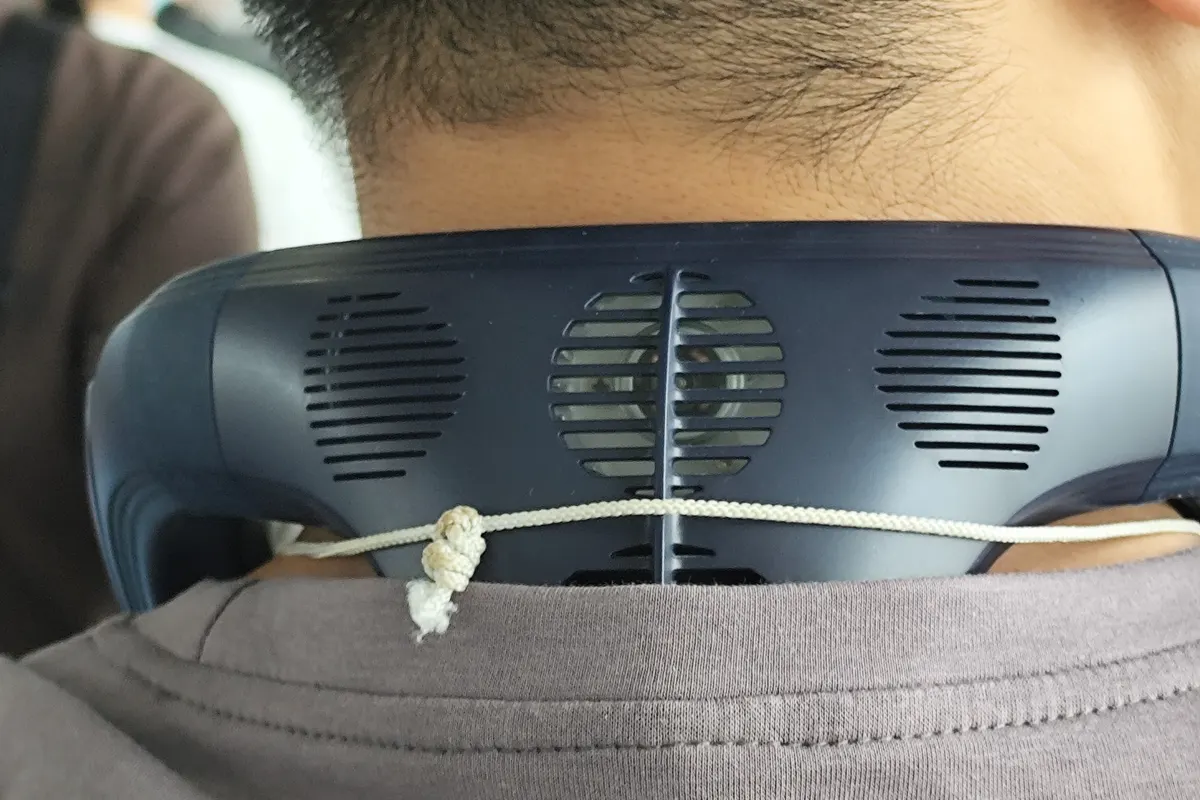
A neck cooler presses a small metal plate against the back of your neck, uses electricity to make that plate cold and vents the heat it removes. It cools a patch of skin, not the air or your whole body. Sony's Reon Pocket Pro Plus costs $259.99 in the U.S., and Torras sells fan-assisted models from $99. The battery hours in ads usually describe the lowest setting.
On this page
- What is a wearable air conditioner?
- How does a neck cooler work?
- Does it cool your body or just your neck?
- What do Sony and Torras sell, and what do they cost?
- How long does the battery really last?
- What do the ads exaggerate?
- When does a neck cooler not work well?
- Who is a neck cooler for?
- What should you look for before buying?
- FAQ
- Sources
"Wearable air conditioner" is a big name for a small gadget. You will see it on neck-worn devices from Sony, Torras and many other brands, and the name suggests something it does not do: cool the air around you. These devices work on one small patch of skin at the back of your neck, and that is both the clever part and the limit.
This guide explains what happens inside a neck cooler, then lines up Sony's Reon Pocket Pro Plus with Torras' Coolify range using the makers' own pages and two independent reviews, all opened on Nov. 2, 2026. Sony's U.S. store blocks automated reading, so the U.S. price comes from the reviews and is marked as such.
What is a wearable air conditioner?
It is a battery-powered band that sits around your neck and lowers the feel of heat on the skin it touches. Sony does not call its device an air conditioner at all: its U.S. press release calls it a "wearable thermo device" for personal cooling and heating. Digital Trends, after wearing the Pro Plus for more than two weeks in 85°F weather, says it is not trying to cool your entire body or replace an air conditioner.
There are two designs, and many models mix them. Contact coolers such as Sony's press a cold plate against your skin. Fan coolers blow air across your neck and face, and some add a cold plate to the airflow. Torras describes its Coolify Air as having a cooling chip plus 36 vents for 360° airflow, so it sits between the two.
How does a neck cooler work?
The cold comes from a thermoelectric module, also called a Peltier module. When electric current runs through it, it carries heat from one face to the other: one side gets colder and the other gets hotter. The hot side is attached to a heat sink so it does not overheat, as the Wikipedia entry on thermoelectric cooling explains. Digital Trends reports that Sony calls the Pro Plus' two modules "Peltier plates."
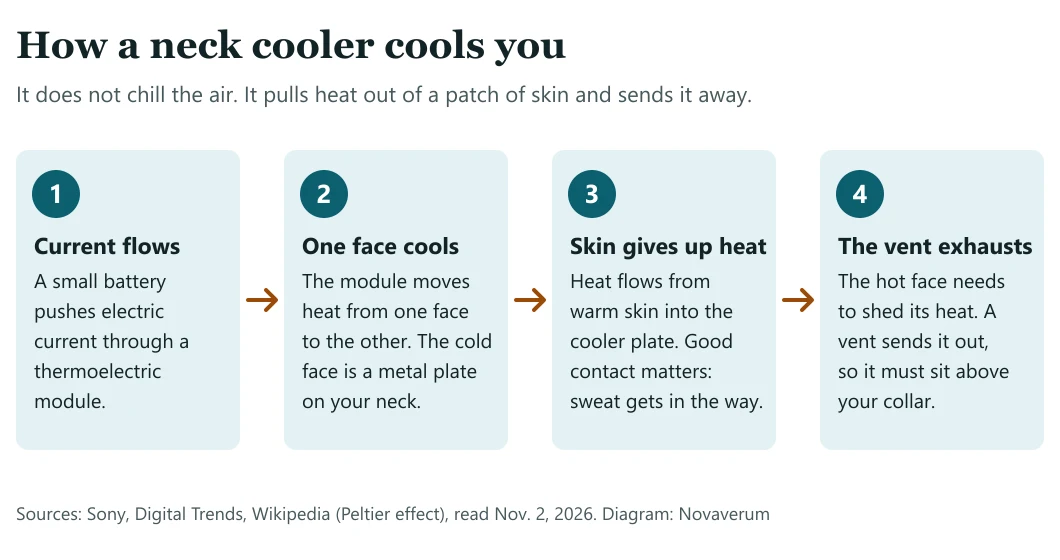
On a Sony Pro Plus, the cold face is a stainless-steel plate that rests on your skin. Warm skin passes heat into the plate, and the hot side of the module sends that heat out through an adjustable vent. That vent matters. Digital Trends noticed the cooling was weaker when the short vent extension on a polo shirt left the warm air with nowhere to go, so the upper vent has to sit outside the collar.
Does it cool your body or just your neck?
It lowers the temperature of a small contact area, and your body reads that as relief. Sony's numbers describe the plate, not you. Its Singapore specifications page says the Pro Plus' SMART COOL mode aims for a plate surface temperature of 20°C (68°F), and that the plate gets about 2°C colder than earlier models. The footnote adds the conditions: after 10 minutes, in a 35°C room, at rest, with "Strong Cooling" set in the app.
That is a useful claim and a narrow one. Feeling cooler is not the same as being cooler, and Digital Trends relays Sony's own guidance on this: in very hot conditions the cooling sensation could make it harder to notice how much heat your body is holding. Sony's page also states the product is not a medical device. I would treat it as a comfort gadget for warm commutes and offices, never as protection against real heat stress.
What do Sony and Torras sell, and what do they cost?
Sony's Reon Pocket Pro Plus is the one that matters for U.S. buyers: Sony's press release calls it the series' first introduction in the U.S. market, after Japan in 2019. Digital Trends lists a $259.99 MSRP, and The Gadgeteer lists $259.99 with Sony and Amazon as places to buy. Sony first said it would sell only through its own online store, and both reviews now also link to Amazon, so compare current stock and return terms in both places.
Torras sells a wider range on its own U.S. store, mostly with fans. The prices below are the ones shown on Nov. 2, 2026. Several are marked down from a higher list price, and the two top models showed as sold out in every color.
| Model | How it cools, per the maker | Headline battery claim | Hours in cooling mode | U.S. price |
|---|---|---|---|---|
| Sony Reon Pocket Pro Plus | Two thermoelectric modules, stainless-steel plate, adjustable vent | Up to 15 hours (SMART COOL) | About 34 hours at Level 1, down to about 5.5 at Level 5 | $259.99 |
| Torras Coolify Air | TEC cooling chip with 36 vents | 4 to 24 hours, by mode | Not listed on the page | $99 |
| Torras Coolify 2S | 8,000 mm² cooling area with two turbines | Up to 28 hours | 5, 4 and 3.5 hours at C1, C2 and C3 | $169 |
| Torras Coolify 2S Pro | Dual semiconductor cooling with 4-channel airflow | Up to 28 hours | Not listed on the page | $199 (sold out) |
| Torras Coolify Cyber Fold | Upgraded TEC chip with 8 air outlets | Up to 15.5 hours | Not listed on the page | $279 (sold out) |
Neck coolers on the makers' pages, Nov. 2, 2026. The U.S. price for Sony comes from Digital Trends and The Gadgeteer.
Sony also sells the lighter Reon Pocket 6 in some countries. Its Singapore page lists 165 g, about 5.5 hours at cooling level 4 and 80% charge in about 60 minutes, against about 10 hours and about 120 minutes for the Pro Plus. Sony's U.S. release covers only the Pro Plus, so I would not plan around the smaller model for now.
How long does the battery really last?
Much less than the headline number, once the cold plate is running. Torras' own FAQ for the Coolify 2S shows it: 28, 17 and 11 hours in wind mode, but 5, 4 and 3.5 hours in cooling mode. The "28 hours" is the fan on its lowest speed. Sony's 15 hours is for SMART COOL under default settings, and its Singapore page notes that this figure comes from a 30°C indoor room at rest.
Sony's level-by-level list is the most honest of the pages I read: about 34 hours at the gentlest cooling level and about 5.5 hours at the strongest. Tom's Guide lists 10 hours and found the battery drained faster on heat mode and on the highest settings. It also reports 130 minutes to reach 90%, and Sony says a full charge takes about 200 minutes. If you plan a long day on the strongest setting, plan to charge it.
What do the ads exaggerate?
Four things come up, and they are easy to check once you know where to look. The habit that catches them is reading the maker's own page before the ad, the same one behind my checklist for fake gadget videos, and it works on real products too.
- The word "air conditioner." Nothing here cools a room or even the air around you. It moves heat out of one patch of skin.
- "Instant" cooling. Torras' Cyber Fold page says it "cools to 60.8°F in just 1 second," and the 2S Pro page promises an "instant 12°C temperature drop" in Hyper Mode. Neither page says what is being measured or under what conditions, so I read these as plate figures at best.
- Battery hours. The big number is almost always the lowest setting or fan-only mode, as the Coolify 2S FAQ shows.
- Whole-body relief. Digital Trends lists "not as effective as a blowing fan" among the Pro Plus' cons, and that is the honest trade: a contact plate is quiet and discreet, but a fan moves more air.
None of this makes the devices bad. It means the specs are about the plate and the battery at its gentlest, while what you care about is how you feel after an hour on a warm train.
When does a neck cooler not work well?
The same few situations come up in Sony's guidance and in both reviews:
- Exercise. Sony does not recommend wearing the Pro Plus while exercising. Sweat sits between your skin and the plate and cuts the cooling, as Digital Trends explains.
- Loose fit. Contact is the whole point. Sony's release says stable contact is critical for effective heat transfer, which is why the neckband is adjustable and fits necks of different sizes.
- Blocked vent. A vent trapped under a high collar or jacket cannot get rid of the heat, so the cooling drops.
- Reaching the buttons. Tom's Guide found the on-device buttons hard to reach while wearing it and used the phone app as a remote instead. The smart modes and fine adjustments live in the app, which needs iOS 16 or Android 9 or newer.
- Sleeping on your back. Tom's Guide notes you cannot wear it at night if you lie on your back.
Who is a neck cooler for?
For a person who is warm but not working hard: a commute, a flight, a hot walk to lunch, an office where the air conditioning never suits everyone. Digital Trends names airplanes and offices as the places where it makes the most sense. Tom's Guide describes using it in an office where the air conditioning keeps changing, and as personal heating, since Sony's device can also warm.
My read: if what you want is airflow on your face, a $99 fan-and-plate model from Torras is a different product from Sony's $259.99 contact cooler, not a cheaper version of it. Digital Trends' roundup describes Torras' Cyber Fold as much quicker at lowering the temperature, while its Pro Plus review calls Sony's device quieter and more discreet than a neck fan. If the job is workouts or heavy sweating, neither type is the right tool. For more of my notes on gadgets that sit on the body, see my guides to smart rings, powered exoskeletons for hiking, translator earbuds and smart glasses.
What should you look for before buying?
Look at three things on the maker's page. First, find the battery figure for cooling mode, not the headline: if the page does not list it, as is the case for three of the Torras models above, ask what the number means. Second, check what the temperature claim measures and under what conditions. Third, check stock and return terms on the maker's own store, since the two Torras flagships were sold out and Sony first named its own store as the only U.S. seller. I would also take Sony's advice at face value and keep it for comfort, not for work in dangerous heat.
Frequently asked questions
Does a wearable air conditioner actually cool the air?
No. Neck coolers lower the temperature of the patch of skin they touch, or move air across it. Sony calls its Reon Pocket Pro Plus a "wearable thermo device," and Digital Trends says it is not trying to cool your entire body or replace an air conditioner.
How does the Sony Reon Pocket Pro Plus cool you?
Through two thermoelectric (Peltier) modules that press a stainless-steel plate against your neck and carry heat from your skin out through an adjustable vent. In SMART mode, sensors read skin temperature and the app sets the range you prefer.
How much does the Sony Reon Pocket Pro Plus cost in the U.S.?
Digital Trends lists a $259.99 MSRP and The Gadgeteer lists $259.99 too. Sony's release said U.S. sales would go through its online store, so check the current price and stock there.
Is a Torras Coolify neck air conditioner cheaper?
Yes. On Torras' U.S. store on Nov. 2, 2026, the Coolify Air was $99, the Coolify 2S $169, the 2S Pro $199 and the Cyber Fold $279, with the last two sold out. These use fans plus a cooling chip, so they are a different design from Sony's contact plate.
How long does a neck cooler battery last?
It depends heavily on the mode. Torras lists the Coolify 2S at 28 hours in wind mode but 3.5 to 5 hours in cooling mode. Sony lists the Pro Plus at about 34 hours at the gentlest cooling level, about 5.5 hours at the strongest and up to 15 hours in SMART COOL.
Are neck coolers quiet?
Sony pitches the Pro Plus as quiet, and its U.S. release calls it fan-less, while its Singapore page mentions a custom silent fan and Digital Trends noted a small fan cools the modules. Torras lists 31 dB for the Coolify Air. Fan-style models are generally the louder type.
Can you wear a neck cooler while exercising?
Sony does not recommend wearing the Pro Plus while exercising, because sweat gets between your skin and the plate and reduces its effect. Digital Trends adds that feeling cooler is not the same as being cooler in very hot conditions.
Does a neck cooler also heat?
Sony's Pro Plus does: it has four warming levels, listed at about 10 hours at the gentlest and about 5.5 hours at the strongest. Torras' Coolify 2S lists heating mode as well, at 6, 5 and 4 hours.
Sources
- Sony Electronics Inc. press release on PR Newswire: REON POCKET PRO Plus (May 12, 2026), read Nov. 2, 2026
- Sony Store Singapore: REON POCKET PRO Plus (specifications, battery levels, footnotes), read Nov. 2, 2026
- Sony Store Singapore: REON POCKET 6 and series comparison, read Nov. 2, 2026
- Digital Trends: Sony REON Pocket Pro Plus review (undated, read Nov. 2, 2026)
- Tom's Guide: Reon Pocket Pro Plus review (written before the U.S. launch), read Nov. 2, 2026
- The Gadgeteer: Sony REON POCKET PRO Plus, $259 wearable AC hits the US (July 1, 2026, updated Nov. 2, 2026)
- Torras U.S. store: COOLiFY Air (price and specifications), read Nov. 2, 2026
- Torras U.S. store: COOLiFY 2S (price, battery FAQ), read Nov. 2, 2026
- Torras U.S. store: COOLiFY 2S Pro (price and specifications), read Nov. 2, 2026
- Torras U.S. store: COOLiFY Cyber Fold (price and specifications), read Nov. 2, 2026
- Wikipedia: Thermoelectric cooling (Peltier effect), read Nov. 2, 2026

Founder and editor, Novaverum
I write Novaverum to separate the technology you can really buy from the demos, concepts and viral fakes, starting from what the companies, regulators and engineers publish. Every article lists its sources at the end.