Wearables & Gadgets
Powered Exoskeletons for Hiking: What They Do and Cost
Quick answer
A powered hiking exoskeleton is a motorized hip or knee frame that pushes your legs along on climbs, and it costs $689 to $1,999 from Hypershell and Dnsys. The hip models weigh about 1.6 to 2.6 kg. Reviewers found the help clearest going uphill and weakest going downhill, and both makers say it is not a medical device.

On this page
- What does a powered hiking exoskeleton do?
- How much does a hiking exoskeleton cost?
- How much help do you get on a trail?
- Does it help downhill or on rough ground?
- How long does the battery last on a hike?
- How heavy is it, and is it loud?
- Is a hiking exoskeleton a medical device?
- Who is a hiking exoskeleton for?
- Is it real or a viral video?
- What should you check before you buy one?
- FAQ
- Sources
A hiking exoskeleton sounds like a movie prop, but you can order one today. It is a motorized frame that straps around your hips or knees and pushes your legs along, so climbs and long days take less effort. Two brands sell most of them to consumers, Hypershell and Dnsys, and both publish prices, weights and battery figures on their own sites.
This guide uses those pages, read on October 26, 2026, plus three independent reviews. The goal is to separate what the machines do from what the marketing claims.
What does a powered hiking exoskeleton do?
Most consumer models are hip exoskeletons. A belt sits around your waist, a motor at each hip adds force to your stride, and the pack runs on a battery you can swap on the trail. Dnsys lists its X1 at "up to 1.2 horsepower of assistance," which is about 900 W, and Hypershell lists up to 1,000 W for its two top models and 800 W for the X Pro S.
Knee models work lower down. Dnsys sells the Z1, with 900 W motors and a frame that sits behind the thigh and calf, and markets it as the "world's first knee exoskeleton for outdoor." We found no independent test of the Z1, so the rest of this guide leans on the hip models.
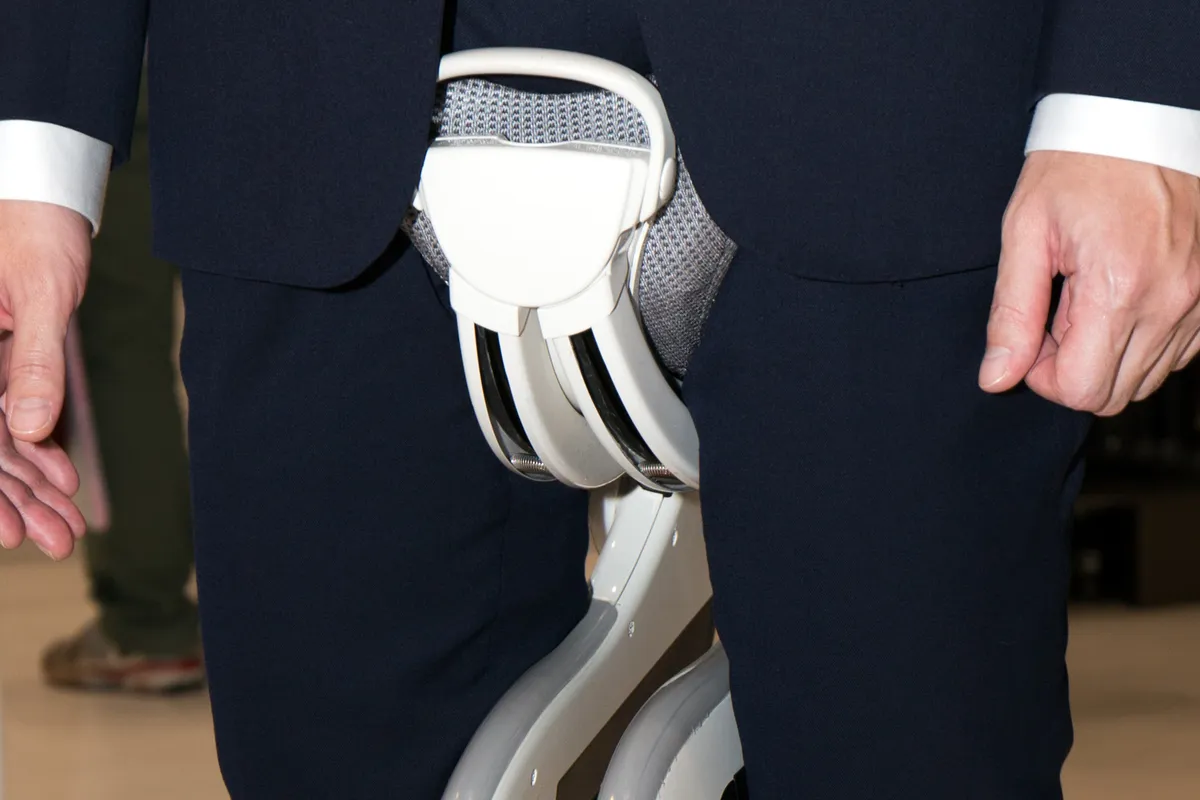
The idea is not new. The photo above shows a 2011 prototype built to carry a heavy backpack, and car makers showed walking-assist frames years ago. What changed is that consumer models now sell online with a warranty and a 14-day return window.
How much does a hiking exoskeleton cost?
From $689 for Dnsys's entry hip model to $1,999 for Hypershell's X Ultra S and Dnsys's Z1 Dual Joint Pro. Hypershell shows one price per model and no discount. Dnsys shows a crossed-out list price next to every sale price, so its savings look large on paper.
| Model | Type | Price | Weight | Power | Range |
|---|---|---|---|---|---|
| Dnsys X1 Lite | Hip | $689 (list $999) | 1.6 kg* | 1.2 hp (about 900 W) | 15 km per battery |
| Dnsys X1 Carbon | Hip | $889 (list $1,299) | 1.6 kg* | 1.2 hp | 15 km per battery |
| Dnsys X1 Carbon Pro | Hip | $1,289 (list $1,999) | 1.6 kg* | 1.2 hp | 30 km, two batteries |
| Hypershell X Pro S | Hip | $999 | 2,585 g | 800 W | 17.5 km per charge |
| Hypershell X Max S | Hip | $1,499 | 2,571 g | 1,000 W | 30 km, one battery |
| Hypershell X Ultra S | Hip | $1,999 | 2,538 g | 1,000 W | 30 km per battery, two batteries |
| Dnsys Z1 Dual Joint | Knee | $1,299 (list $1,499) | 640 to 680 g per leg | 900 W | 15 km per battery |
| Dnsys Z1 Dual Joint Pro | Knee | $1,999 (list $2,298) | 640 to 680 g per leg | 900 W | 30 km, two batteries |
Prices, weights and ranges as listed by each maker on Oct. 26, 2026. Dnsys's list prices are the crossed-out figures on its store. All figures are the makers' claims.
*Dnsys lists 1.6 kg as the mechanical weight for the X1 line, not per model. Weight with batteries is higher, as the reviews below show.
Prices move. Notebookcheck gave the X1 Carbon Pro's regular price as $1,899 in November 2025 and $1,499 during Black Friday. Dnsys's store now shows $1,289 against a crossed-out $1,999.
How much help do you get on a trail?
The makers give big numbers without much context. Hypershell's hiking section promises "up to 42%" lower average heart rate, with a footnote that figures "vary by model" and no test conditions on the page. Dnsys's FAQ says the X1 can "decrease power demand by up to 50%," with no conditions given either.
Independent testers describe something smaller and more specific. Notebookcheck's David Chien found the X1 Carbon Pro made walks, runs and hikes up moderate hills roughly a quarter to a third easier. Countryfile's Leonie Helm wrote that steep scree, which usually leaves her quads "grumbling after a few hundred meters," felt lighter with the original X Ultra, and that it "undeniably changes the rhythm of a long hike."
The Wall Street Journal's Nicole Nguyen tested the X Ultra S and wrote: "Going uphill, with the torque notched up, I really felt the exoskeleton at work." She also reported sore calves for several days afterward and said she was not sure exoskeletons are ready for the mainstream, though she saw appeal for early adopters, people getting active, older hikers and athletes who want extra resistance.
Does it help downhill or on rough ground?
Much less. Countryfile found the support on descents "limited," and said the X Ultra "wasn't the best scrambling up large rocks." Nguyen found that the system does not detect descents on its own, so you switch on a Downhill mode in the app: "Descents can be exhausting but the AI isn't smart enough to detect them."
Notebookcheck's tester added a caution about the Dnsys: it can't help with balance or sense shoe grip, and in Boost mode a slight lag in assistance can cause slips during hard sprints. If your hikes are mostly steep climbs, that is a small price. If they are mostly rock hopping, the machine adds little.
How long does the battery last on a hike?
Longer than a typical day hike in the lowest assist setting, and much shorter in the highest. Hypershell lists 30 km on its Eco range chart for the Max S and Ultra S (the Ultra S ships with two batteries), and 17.5 km for the Pro S. The Journal says the company claims about 18 miles per charge, roughly double with the second pack that comes with the Ultra S. Dnsys lists 15 km per battery and a "3-second battery swap," and says the Carbon Pro's two batteries give 30 km in total.
Real use was shorter whenever the testers pushed the assist. Countryfile said the Eco mode can last a full day of hiking on one battery, but Hyper mode drains quickly and the reviewer swapped batteries before lunch. Nguyen's battery died soon after she got home, which she put down to using the Boost setting heavily. Notebookcheck rated the X1's batteries at up to 20 km each, charging in about two hours, and expected one to two hours per battery on mixed terrain, depending on speed, mode and slope.
How heavy is it, and is it loud?
Hypershell's S models are listed at 2.5 to 2.6 kg, and the Dnsys X1 at 1.6 kg of hardware. Weighed with a battery, Countryfile measured the original X Ultra at 2.2 kg (1.8 kg without it), and Notebookcheck measured the X1 Carbon Pro at 2.09 kg fully equipped. Helm found the Hypershell easy to put on and comfortable, with little muscle ache after a 12-mile hike.
Two of the reviewers heard the motors. Nguyen described a whirring that gets louder as you raise the assistance, and Notebookcheck lists the audible motors as a drawback. Neither source gives a decibel figure.
Is a hiking exoskeleton a medical device?
No, and both makers say so. Hypershell's pages read: "Lifestyle power. Not a medical aid. Requires unassisted walking and balance," and add that it is "designed for individuals who can walk independently." Dnsys calls the X1 and Z1 "a mobility aid, not a medical/rehabilitation device," says its algorithm does not help with balance, and its Z1 page tells anyone with health issues or recent surgery to consult a healthcare professional.
Both are rated IP54 for dust and splashes. Dnsys advises against heavy rain and against submerging the X1.
Who is a hiking exoskeleton for?
The clearest fit is someone who hikes long days with big climbs and often carries a pack, and who is happy to pay for a bit less leg effort. Countryfile calls the Hypershell fun and genuinely helpful, but expensive for occasional use, and "not a substitute for skill, ability and fitness." Notebookcheck calls the Dnsys X1 a lightweight boost for everyday walking, running and moderate hills.
If most of your trail time is rocky scrambling or steep descents, the evidence points the other way. The same goes for anyone who hikes a handful of times a year: at $689 to $1,999, you would be paying for a machine that sits in the closet.
Is it real or a viral video?
Real. Both brands have store pages with prices, spec sheets, warranty terms and return policies, and outlets including The Wall Street Journal and Notebookcheck have tested them. That passes the checks in our guide to spotting a fake gadget video.
What deserves a second look are the biggest claims. The 42% lower heart rate and the 50% lower power demand come from the makers, and the pages we read give no test conditions. The only independent figure we found is Notebookcheck's quarter to a third, for walks, runs and moderate hills, and testers describe downhill help as limited.
If you like wearable machines, see our guides to the jet suit and to smart glasses, or browse all Wearables & Gadgets articles. For machines that carry the whole person, there are air taxis and floating hoverboards.
What should you check before you buy one?
Three things are worth reading before checkout.
- Size. Dnsys lists a waist of 70 to 125 cm and a thigh length of 40 to 62 cm for the X1, and a height of 150 to 196 cm and a weight of 40 to 122 kg for the Z1. Hypershell gives no numeric limits and points to a size tool on its page.
- Returns. Hypershell lists 14-day returns, a 12-month warranty and a 7-day price match, with full terms on separate policy pages we did not read. Dnsys's return page says the 14-day window covers unopened, unactivated items, excludes accessories and the Carbon Pro, and charges return shipping (US$12 from the US) and a payment fee on non-defect returns.
- Batteries. Dnsys warns not to mix batteries or chargers between the X1 and the Z1, so buy spares for the same model.
Frequently asked questions
Do hiking exoskeletons really work?
On climbs, reviewers say yes: Notebookcheck found the Dnsys X1 Carbon Pro made hikes up moderate hills roughly a quarter to a third easier, and Countryfile and The Wall Street Journal both felt the Hypershell uphill. Downhill and rocky ground got much less help.
How much does a hiking exoskeleton cost?
From $689 for the Dnsys X1 Lite to $1,999 for the Hypershell X Ultra S or the Dnsys Z1 Dual Joint Pro, as listed on the makers' own sites on October 26, 2026. Prices change, and Dnsys shows large crossed-out list prices.
How heavy is a hiking exoskeleton?
Hypershell lists 2,538 to 2,585 g for its S models, and Dnsys lists 1.6 kg of mechanical weight for the X1. Notebookcheck measured the X1 Carbon Pro at 2.09 kg fully equipped, and Countryfile measured the original Hypershell X Ultra at 2.2 kg with a battery.
How far can a hiking exoskeleton go on one charge?
The makers list 15 to 30 km per battery. Reviewers got less when they used the strongest assist: Countryfile swapped a battery before lunch in Hyper mode, and Notebookcheck expected one to two hours per battery on mixed terrain.
Does an exoskeleton help going downhill?
Only a little. Countryfile called downhill support limited, and The Wall Street Journal said the Hypershell does not detect descents, so you turn on a Downhill mode in the app.
Should I choose a hip or a knee exoskeleton?
Hip models are the ones reviewers tested, and they come from both brands. Dnsys's Z1 knee model is marketed for outdoor use, but we found no independent test of it.
Is a hiking exoskeleton a medical device?
No. Hypershell says it is not a medical aid and needs unassisted walking and balance, and Dnsys calls its models a mobility aid, not a medical or rehabilitation device.
Can you use a hiking exoskeleton in the rain?
Both brands list an IP54 rating, which covers dust and splashes. Dnsys advises against heavy rain and against submerging the X1.
Sources
- Hypershell: home page (X Ultra S, X Max S, X Pro S prices, weights, range), read Oct. 26, 2026
- Hypershell: New X Series (specs, accessories, warranty, medical disclaimer), read Oct. 26, 2026
- Hypershell: X series size guide and "not a certified medical device" notice, read Oct. 26, 2026
- Dnsys: X1 hip exoskeleton (prices, specs, FAQ, safety notes), read Oct. 26, 2026
- Dnsys: Z1 knee exoskeleton (prices, specs, size range), read Oct. 26, 2026
- Dnsys: Return policy, read Oct. 26, 2026
- The Wall Street Journal (via To Vima): E-hiking is here, by Nicole Nguyen (June 2026)
- Countryfile: Hypershell X Ultra review, by Leonie Helm (Oct. 30, 2025)
- Notebookcheck: Dnsys X1 Carbon Pro hands-on, by David Chien (Nov. 20, 2025, updated Oct. 5, 2026)

Founder and editor, Novaverum
I write Novaverum to separate the technology you can really buy from the demos, concepts and viral fakes, starting from what the companies, regulators and engineers publish. Every article lists its sources at the end.