Reality Check
Is There a Real Hoverboard That Floats? The Facts
Quick answer
Yes, but not the kind you can ride down the street. Floating hoverboards exist as prototypes and demos. The Lexus board needs a magnetic track and liquid nitrogen, the Hendo board needs a copper or aluminum surface, and the ArcaBoard uses 36 fans for up to six minutes. Zapata's Flyboard Air flies on jet engines. None of them floats over ordinary ground.

On this page
- Is there a real hoverboard that floats?
- How did the Lexus hoverboard float?
- Why does it only work over a special track?
- How does the Hendo hoverboard work?
- Does the ArcaBoard really float, and for how long?
- Is Zapata's Flyboard Air a hoverboard?
- What are the "hoverboards" sold in stores?
- Will a real hoverboard ever float over any ground?
- FAQ
- Sources
Since Back to the Future Part II in 1989, a skateboard that floats above the street has been the gadget everyone wants. The film set it in 2015. In 2026, is there a real hoverboard that floats? There is, in a few forms. The catch is what each one needs in order to float, and none of those needs is a sidewalk.
Every fact below comes from the makers' own pages, from consumer-safety records or from reporting on the boards, read on October 23, 2026. The sources are listed with dates at the end.
Is there a real hoverboard that floats?
Yes, in the sense that boards have lifted a rider off the ground with no wheels. Four different approaches have been shown since 2014. They float in very different ways, and each one trades something away.
| Board | How it floats | What it needs | Status |
|---|---|---|---|
| Lexus Hoverboard (2015) | Superconductors cooled to −197 °C over permanent magnets | A custom magnetic track and liquid nitrogen | "Remains a prototype and will not be on sale" |
| Hendo Hoverboard (2014) | Four "hover engines" make a magnetic field | A copper or aluminum surface; about an inch up; under 10 minutes | Prototype; US$ 10,000 backer tier |
| ArcaBoard (2015) | 36 electric ducted fans | Flat ground; up to 30.5 cm up; up to six minutes | Listed at US$ 19,900, deliveries announced for April 2016 |
| Zapata Flyboard Air | Five jet engines | Jet A1 fuel and open space | Flies; a 2,252.4 m record in 2016; no price on its page |
| Store "hoverboards" | They do not float: two wheels | A charged battery | On sale; some were recalled for battery fires |
The real "floating" boards compared, as described by their makers and reporters. Figures are the sources' own.
How did the Lexus hoverboard float?
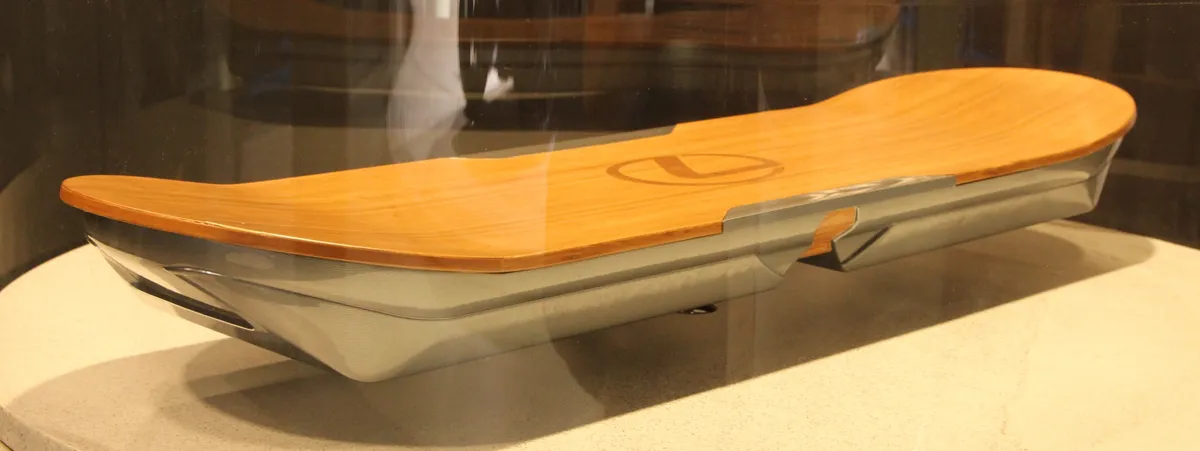
With a cooled superconductor and a magnetic track. Lexus said the board carries two cryostats, which are reservoirs where "superconducting material is kept at -197 degrees through immersion in liquid nitrogen." It was then placed above a track holding permanent magnets. Lexus tested it in a purpose-built "hoverpark" in Cubelles, near Barcelona, with up to 200 meters of magnetic track under the surface.
The trick is how a superconductor handles a magnetic field. The release explains that the track's field is effectively frozen into the board's superconductors, and that keeps the board floating. Inside Science, quoting a Lawrence Berkeley National Laboratory physicist, describes the same idea: once cold, the superconductor gets "stuck" on the field lines of the magnets below it.
Why does it only work over a special track?
Because the floating comes from the track, not from the board alone. A superconductor needs a magnetic field to push against, and an ordinary street has none. The same physics is a standard classroom demonstration: a 2008 physics paper describes levitating and suspending a superconductor over a magnetic track as "inexpensive and easy to construct."
At street scale it gets expensive. The Inside Science physicist said strong rare-earth magnets would be needed under the surface and "it isn't cheap." Add the liquid nitrogen that keeps the board cold, and it is easy to see why Lexus built one park and said the board "remains a prototype and will not be on sale."
How does the Hendo hoverboard work?
It floats by pushing against a metal surface. The Hendo Hoverboard, shown in October 2014, has four "hover engines" under the board that create a changing magnetic field. Its inventors called the method Magnetic Field Architecture. Over a non-ferromagnetic conductor such as copper or aluminum, the board is pushed up by the opposing magnetic forces.
The limits were stated up front. New Atlas reported that the prototype hovered about an inch above the surface and that its batteries were good for less than 10 minutes. The company took backers on Kickstarter, with a US$ 10,000 level for a board that sold out at 10 units and a US$ 250,000 goal. The pages we read give no shipping or delivery update after that.
Does the ArcaBoard really float, and for how long?
It does, with fans. The ArcaBoard from ARCA, announced on December 24, 2015, uses 36 electric ducted fans, which push air down the way a large drone does. Dezeen reported that it rises up to 30.5 cm (one foot) and gives up to six minutes before the board needs recharging. Another page lists a maximum load of 110 kg.
It was also the one board that had a price and a date. Dezeen reported US$ 19,900, available from April 2016. We could not find a current ARCA page that sells it, so treat it as a past offer, not a product you can order today.
Is Zapata's Flyboard Air a hoverboard?
It is the one that flies the farthest, but it does not float. French inventor Franky Zapata's Flyboard Air has "5 jet engines" and a Jet A1 fuel tank, according to Zapata's page. On April 30, 2016, it set the Guinness World Record for farthest flight by hoverboard: 2,252.4 m (7,389 ft 9 in) at Sausset-les-Pins, France, beating the previous record by nearly 2 km.
Zapata crossed the English Channel on the board on August 4, 2019, a roughly 22-mile trip with a refueling stop in the middle. The Flyboard Air page we read gives no price and no consumer sale, and describes a separate EZ-Fly aimed at military use.
What are the "hoverboards" sold in stores?
Two-wheeled scooters. The U.S. Consumer Product Safety Commission (CPSC) uses the name "self-balancing scooters/hoverboards" and describes them as having "two wheels at either end of articulated dual platforms." They do not float at all. In a July 2016 recall of Razor's Hovertrax, the CPSC said the battery packs "can overheat, posing a risk of the products smoking, catching fire and/or exploding."
If the board in a listing has wheels, it is this product and not a levitating one. Search CPSC.gov for recalls before you buy.
Will a real hoverboard ever float over any ground?
Nothing in the sources we read shows it yet. Each board gets its lift from somewhere: a track, a metal surface, fans or fuel. Each pays for it in the same few ways, which are time aloft, noise, cost or the ground you need. A board that floats over any ground, quietly, for hours, has not been shown by any maker.
That also tells you how to read a viral clip. A rider gliding over a plain street with no track, no fans, no noise and no fuel is a reason to run the eight checks in our guide to spotting a fake gadget video. And if you want to leave the ground this year, the one option on our list that you can book is the jet suit, which flies on a tether for a few minutes from £799.
Frequently asked questions
Is there a real hoverboard that floats?
Yes, as prototypes and demos. Lexus showed one that floats over a magnetic track, Hendo one that floats over copper or aluminum, and ARCA one that floats on 36 fans for up to six minutes. None floats over ordinary ground.
Can I buy a hoverboard that floats?
Not from the sources we read. Lexus said its board "will not be on sale." ARCA listed the ArcaBoard at US$ 19,900 with deliveries announced for April 2016, but we found no current page selling it. Store "hoverboards" have two wheels and do not float.
How does the Lexus hoverboard work?
Superconductors in the board are cooled to −197 °C with liquid nitrogen and placed over a track of permanent magnets. The track's magnetic field is effectively frozen into the superconductors, which keeps the board floating.
Does the Hendo hoverboard work on concrete?
No. It needs a non-ferromagnetic conductor such as copper or aluminum under it. In 2014 reports it hovered about an inch up, with batteries good for less than 10 minutes.
How long can the ArcaBoard fly?
Up to six minutes per charge, at a height of up to 30.5 cm (one foot), according to Dezeen's 2016 report. Its page on evtol.news lists a maximum load of 110 kg.
Is the Back to the Future hoverboard real?
No. The board in Back to the Future Part II (1989), set in 2015, floats over any surface. None of the real boards above does.
What are the hoverboards sold in stores?
They are self-balancing scooters with two wheels. They do not float, and some models have been recalled for batteries that can overheat. Check CPSC.gov for recalls before you buy.
Sources
- Toyota Global Newsroom: Lexus Hoverboard Ride Revealed (Aug. 5, 2015)
- AIP Inside Science: How the Lexus hoverboard gets off the ground (June 26, 2015)
- arXiv: A Classroom Demonstration of Levitation and Suspension of a Superconductor over a Magnetic Track (Mar. 20, 2008)
- New Atlas: Hendo Hoverboard prototype (Oct. 22, 2014)
- Dezeen: ArcaBoard uses high-powered fans to hover across the ground (Jan. 8, 2016)
- eVTOL News: ARCA Aerospace Corporation ArcaBoard (read Oct. 23, 2026)
- Guinness World Records: Farthest flight by hoverboard (Apr. 30, 2016)
- Zapata: Flyboard Air (read Oct. 23, 2026)
- Flying Magazine: Zapata Flyboard Channel crossing (Aug. 2019)
- U.S. Consumer Product Safety Commission: Razor recalls self-balancing scooters/hoverboards (July 6, 2016)
- Wikipedia: Hoverboard (read Oct. 23, 2026)

Founder and editor, Novaverum
I write Novaverum to separate the technology you can really buy from the demos, concepts and viral fakes, starting from what the companies, regulators and engineers publish. Every article lists its sources at the end.