Wearables & Gadgets
Smart Rings in 2026: What They Track and What They Cost
Quick answer
A smart ring tracks sleep, heart rate, activity and skin temperature from your finger, and in 2026 the makers' own pages start at $299.99 for Samsung's Galaxy Ring, $349 for RingConn Gen 3 and $349 for the Oura Ring 4. The bigger difference comes after the purchase: Oura charges $5.99 a month for its full app, while RingConn and Ultrahuman say their rings have no subscription.
On this page
- What does a smart ring track?
- How much do smart rings cost in 2026?
- What do you get with an Oura Ring?
- What does the Samsung Galaxy Ring offer?
- Which smart rings have no subscription?
- What does a smart ring really cost over two years?
- Are smart rings medical devices?
- What should you look at before you order a smart ring?
- Which smart ring fits which person?
- FAQ
- Sources
A smart ring is a band of titanium or ceramic, a few millimeters thick, with sensors on the inside that read your finger. It has no screen. You wear it day and night, and everything it measures shows up in a phone app. This guide covers four brands that sell rings in the United States, and they differ more in how they charge than in what they measure. It covers what each one says it tracks, how long the battery lasts and what you will pay.
Prices and specifications below come from the four makers' own store pages, which I read on October 31, 2026. Those pages show no date of their own, so treat prices and stock as a snapshot of that day. The links are at the bottom.
What does a smart ring track?
Less than a smartwatch, and nearly the same core list. The sensors are small: a light that reads blood flow through the finger, a thermometer for skin temperature and a motion sensor. From those the apps build scores for sleep, recovery and activity.
Oura lists four sensors on its Ring 4 page: red and infrared lights for blood oxygen, green and infrared lights for heart rate, heart rate variability and respiration rate, a temperature sensor for trends and an accelerometer for movement. Samsung names three for the Galaxy Ring: an accelerometer for walking and running, an optical sensor for heart rate and a skin temperature sensor that takes readings while you sleep. Ultrahuman lists a temperature sensor, a redesigned PPG sensor and a six-axis motion sensor for its Ring PRO. RingConn's Gen 3 page lists heart rate, blood oxygen, steps, heart rate variability, sleep time and respiratory rate.
How much do smart rings cost in 2026?
Between $299.99 and $479 for the ring itself, depending on the brand. The table lists the cheapest current model each maker shows, with the battery claim from its page.
| Ring | Starting price | Battery claim | Monthly fee |
|---|---|---|---|
| Samsung Galaxy Ring | $299.99 before trade-in | Up to 7 days (6 on smaller sizes), 14 with the case | None listed on the page |
| RingConn Gen 3 | $349 (out of stock when I read it) | 11 to 14 days, 150+ with the case | None |
| Oura Ring 4 | $349 | 5 to 8 days | $5.99 a month or $69.99 a year |
| Oura Ring 5 | $399 | 6 to 9 days | $5.99 a month or $69.99 a year |
| Ultrahuman Ring PRO | $479, with charging case | Up to 15 days, 45 with the case | None for your data; paid add-ons |
Starting prices, battery claims and fees as listed on the makers' own pages on Oct. 31, 2026.
Battery numbers are the makers' claims, and each page says they vary with ring size and use. Samsung and Oura both give a range because a bigger ring holds a bigger battery.
What do you get with an Oura Ring?
Oura is the best-known name, and it sells two generations side by side. The Ring 5 starts at $399 in Silver or Black, and $499 in Gold, Deep Rose, Stealth or Brushed Silver. The Ring 4 starts at $349 in Silver, and Oura's store shows its Stealth at $349 and its Gold at $399, each next to a crossed-out higher price. A ceramic Ring 4 is listed from $399 in Midnight or Cloud.
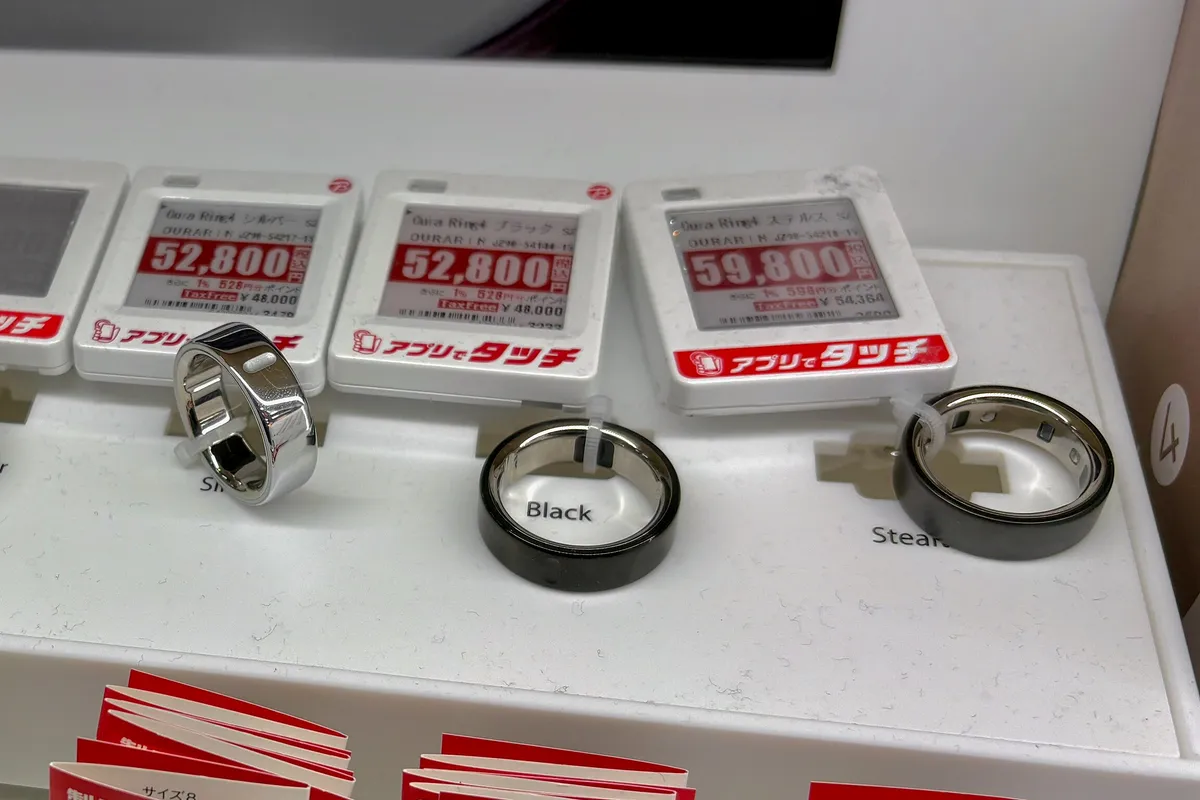
Oura's Ring 4 page lists a titanium body that weighs 3.3 to 5.2 grams, depending on size, water resistance to 100 meters and a battery of 5 to 8 days. The Ring 5 page lists 6 to 9 days, a weight from 2 grams and an IP68 rating. Both work with iPhone and Android.
The membership is the part to read carefully. Oura's membership page lists $5.99 a month or $69.99 a year for U.S. members, and says new members get the first month free. Without it, the page says the ring and app still work, but the insights and personal health data you receive are "much more limited." Oura also says you can export all your data as a CSV file even without a membership. The company lists returns within 30 days of purchase and a limited one-year warranty.
What does the Samsung Galaxy Ring offer?
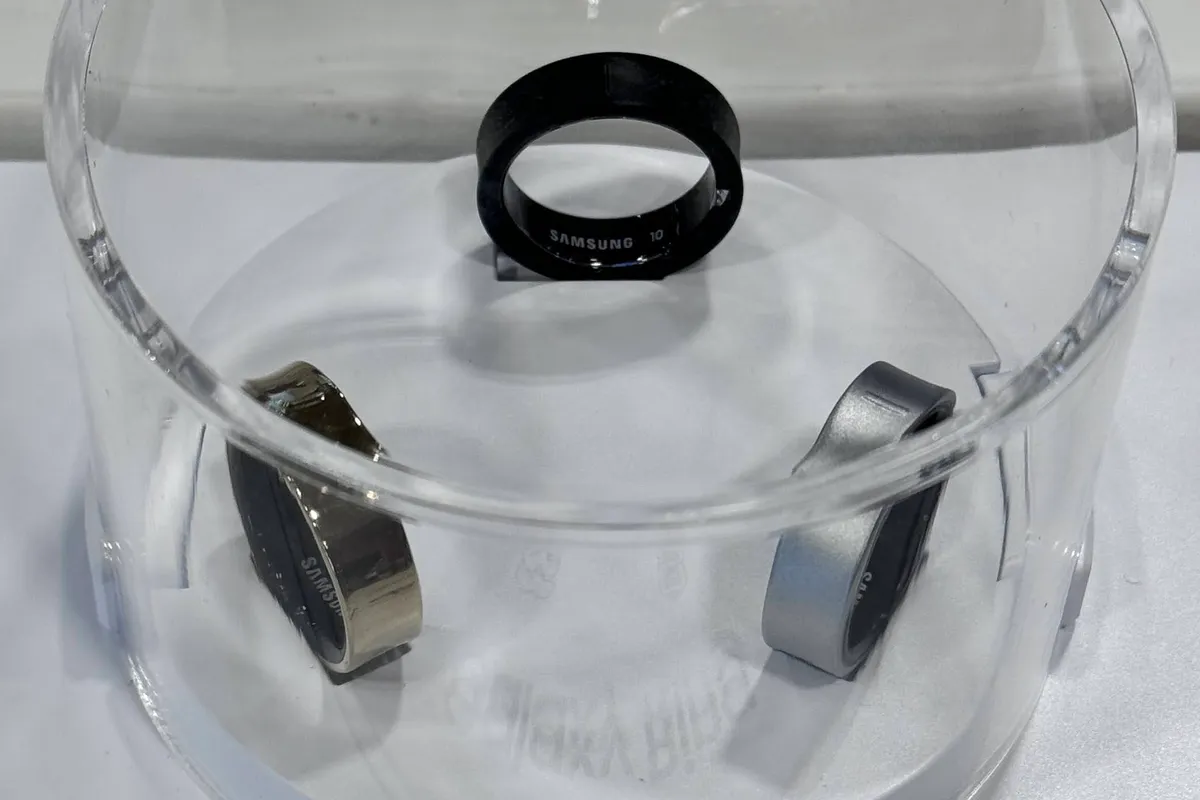
The lowest starting price of the big brands. Samsung lists the Galaxy Ring from $299.99 before any trade-in credit, in titanium with three finishes: Black, Silver and Gold. It lists a battery of up to seven days for sizes 12 and 13 and up to six days for smaller sizes, and says the charging case adds enough for up to 14 days away from a wall outlet. The ring is rated 10ATM and IP68 for water.
Sizing works through a kit that Samsung ships to your home, with sample rings in sizes 5 to 13. You try one on for more than a day, then confirm your order.
The catch is the phone. Samsung's U.S. page says you set the ring up with a Samsung account registered on a Samsung Galaxy smartphone, and that features such as Energy Score and Wellness Tips need a compatible Galaxy AI phone and the Samsung Health app. Samsung's Brazil product page spells out the rest: the ring must be paired with an Android phone running Android 11 or later, with the Galaxy Wearable and Samsung Health apps installed. That rules out an iPhone. Neither page I read mentions a subscription.
The same Brazil page gives the size-by-size weight, which the U.S. page leaves out: 2.3 grams in size 5, rising to 3.0 grams in sizes 12 and 13, with a body 7 mm wide and 2.6 mm thick.
Which smart rings have no subscription?
RingConn and Ultrahuman both say so on their own pages. RingConn's Gen 3 page is titled "No Subscription" and lists $349, 11 to 14 days of battery, up to 150 days with the charging case, a weight of 2.5 to 3.5 grams and a rating of IP68 and 10ATM. It lists sleep stages, sleep apnea risk, cycle tracking and "vascular health trends" next to the basics. RingConn says new U.S. orders come with three months of Strava. When I read the page it showed "Out of stock," and the older Gen 2 ($299) and Gen 2 Air ($199) showed the same, so check stock before you plan around one.
Ultrahuman's U.S. store lists the Ring PRO at $479 with its charging case, up to 15 days of battery (45 with the case) and a weight of 3.3 to 4.8 grams. Its FAQ says there are no recurring fees for accessing your ring data. The company also sells optional paid add-ons it calls PowerPlugs, and a paid UltrahumanX plan, so "no subscription" covers the data, not every feature. The lighter Ring AIR appears in Ultrahuman's comparison table at $349, with 4 to 6 days of battery, but I could not find a U.S. page to order it from.
What does a smart ring really cost over two years?
Add the membership and the price gap between rings changes. This table adds two years of Oura's yearly plan to the ring price and leaves the others at their ring price, since their pages list no recurring charge. It ignores tax, shipping, Oura's free first month and the optional add-ons.
| Ring | Two-year total |
|---|---|
| Samsung Galaxy Ring | $299.99 |
| RingConn Gen 3 | $349.00 |
| Ultrahuman Ring PRO | $479.00 |
| Oura Ring 4 (Silver) and membership | $488.98 |
| Oura Ring 5 (Silver) and membership | $538.98 |
Ring price plus two years of fees, before tax and shipping, using Oct. 31, 2026 prices.
A subscription is also a dependency. A device that leans on the maker's servers works only as long as the maker keeps them running, and I wrote about what that looked like in practice in my guide to the Humane AI Pin shutdown. Oura does say you can export your data as a CSV file even without a membership.
Are smart rings medical devices?
The makers say no, and their own pages say so plainly. Samsung's fine print says the heart rate software functions are not intended for use in the diagnosis of disease, and that cycle tracking is not intended for contraception. RingConn's page says the ring is a health management device, not a medical device, and does not provide blood pressure measurement or medical diagnosis functions.
That shapes how I would read the numbers. A ring is good at showing how your own sleep and heart rate move from week to week, and I would treat a single night's score as a prompt rather than an answer. If a number worries you, that is a question for a doctor, not for the app. The same caution fits any ad or video that promises more than the maker's page does, and the eight checks for a fake gadget video work on ring ads too.
What should you look at before you order a smart ring?
- Your phone. Oura says its app works on iOS and Android. Samsung says the Galaxy Ring pairs only with Android 11 or later, and some features need a Galaxy AI phone.
- Your size. Ring sizes run differently from jewelry. Samsung ships a sizing kit with sizes 5 to 13, and RingConn's return policy says sizing kits are non-refundable.
- The return window. Oura lists 30 days. RingConn accepts returns within 14 days, and only for a defect, a wrong color or a product that differs from its description.
- The monthly fee. Oura's is $5.99, and its page says the app is much more limited without it.
- The stock. Several RingConn models showed "Out of stock" on the day I read the pages.
Rings are one of several wearables that compete for your wrist and your face. The smart glasses pillar covers the ones you wear on your face, and hiking exoskeletons are the other end of the wearable spectrum. Same rule for both as here: the official page, today's price and a clear label for what you can actually order.
If you are comparing wearables that listen, my explainer on translator earbuds covers another one that works with your phone.
Which smart ring fits which person?
If you carry a Galaxy phone and want the lowest entry price, the $299.99 Galaxy Ring is the simple choice. If you want no monthly charge and the longest battery, RingConn Gen 3 and Ultrahuman Ring PRO are the ones to look at, once RingConn is back in stock. If you use an iPhone and want the best-known app, Oura's Ring 4 at $349 is the established pick, and the Ring 5 is the thinner, newer one. My read is that the monthly fee decides it for most people: add it up before you choose a ring. The Oura Ring 4 and RingConn Gen 3 both list at $349, and after two years of Oura's yearly plan they sit $139.98 apart.
Frequently asked questions
How much does a smart ring cost in 2026?
Samsung lists the Galaxy Ring from $299.99 before trade-in, RingConn lists Gen 3 at $349, Oura lists the Ring 4 from $349 and the Ring 5 from $399, and Ultrahuman lists the Ring PRO at $479 with its charging case.
Does an Oura Ring need a subscription?
Oura lists a membership at $5.99 a month or $69.99 a year for U.S. members, with the first month free for new members. Its page says the ring and app still work without it, but the insights you receive are much more limited.
Which smart rings have no monthly fee?
RingConn titles its Gen 3 page "No Subscription," and Ultrahuman says there are no recurring fees for accessing ring data. Samsung's Galaxy Ring page does not mention a subscription.
Does the Samsung Galaxy Ring work with an iPhone?
No. Samsung's Brazil product page says the ring must be paired with an Android phone running Android 11 or later, and the U.S. page says you set it up with a Samsung account on a Galaxy smartphone. Some features need a compatible Galaxy AI phone.
How long does a smart ring battery last?
The makers claim 5 to 8 days for Oura Ring 4, 6 to 9 for Ring 5, up to 7 for the Galaxy Ring, 11 to 14 for RingConn Gen 3 and up to 15 for Ultrahuman Ring PRO. Each says the number varies with ring size and use.
Can a smart ring diagnose a health condition?
The makers say no. Samsung says its heart rate functions are not intended for diagnosing disease, and RingConn says its ring is not a medical device. Treat the numbers as trends and ask a doctor about any worry.
Sources
- Oura: ring store (Ring 5, Ring 4, Ring 4 Ceramic prices; returns and warranty), read Oct. 31, 2026
- Oura: Oura Ring 4 product page (battery, weight, sensors, compatibility), read Oct. 31, 2026
- Oura: Oura Ring 5 product page, read Oct. 31, 2026
- Oura: membership (price, free month, what works without it), read Oct. 31, 2026
- Samsung: Galaxy Ring (price, battery, sizes, phone requirements, fine print), read Oct. 31, 2026
- Samsung Brazil: Galaxy Ring Titanium Black, size 11 (weight by size, Android requirement; in Portuguese), read Oct. 31, 2026
- RingConn: Gen 3 product page (price, stock, no subscription), read Oct. 31, 2026
- RingConn: Gen 3 specifications and disclaimers, read Oct. 31, 2026
- RingConn: return and refund policy, read Oct. 31, 2026
- Ultrahuman: Ring PRO U.S. store page (price, battery, FAQ, comparison with Ring AIR), read Oct. 31, 2026

Founder and editor, Novaverum
I write Novaverum to separate the technology you can really buy from the demos, concepts and viral fakes, starting from what the companies, regulators and engineers publish. Every article lists its sources at the end.