Wearables & Gadgets
AR Glasses as a Portable Monitor: How XREAL and VITURE Work
Quick answer
AR glasses work as a portable monitor by plugging into a phone, laptop or handheld console over USB-C and showing its screen as a large floating display. XREAL's One Pro lists a 171-inch virtual screen and VITURE's Luma Ultra a 152-inch one, both at $599. The device you plug in must output video over USB-C, and it still does the computing.
On this page
- What are AR glasses as a portable monitor?
- How do the XREAL One Pro and VITURE Luma Ultra compare?
- What does a 171-inch virtual screen really mean?
- What do you need to connect them?
- Can you use AR glasses on a plane?
- How do the screens stay in place when you move your head?
- What did reviewers find?
- How much do they cost?
- Are AR glasses worth it as a portable monitor?
- FAQ
- Sources
A laptop screen is small, a phone screen is smaller, and a handheld console has the smallest of all. A pair of AR glasses tries to fix that by putting a big, private screen in front of your eyes and leaving the device in your pocket or bag. Two well-known pairs are the XREAL One Pro and the VITURE Luma Ultra, both listed at $599.
This guide covers what they are, what you need to connect them, how big the "screen" really is and what reviewers found. Every figure comes from a maker's page or a published review, listed with its date at the end.
What are AR glasses as a portable monitor?
They are glasses with a tiny display for each eye and a USB-C cable that carries the picture from another device. The glasses do not run apps of their own. Your phone, laptop or console does the work, and the glasses show what it sends, as a large flat screen that appears to float a few meters away. Both pairs also have lenses that dim or darken electronically so the picture stands out.
That is a different product from the camera and AI glasses in our guide to smart glasses in 2026. Those have microphones, speakers and an assistant, and they work from a phone app. These are screens first. XREAL's Aura, covered in that guide, is a separate, standalone Android XR product at $1,279 as a pre-order, and not the one discussed here.
How do the XREAL One Pro and VITURE Luma Ultra compare?
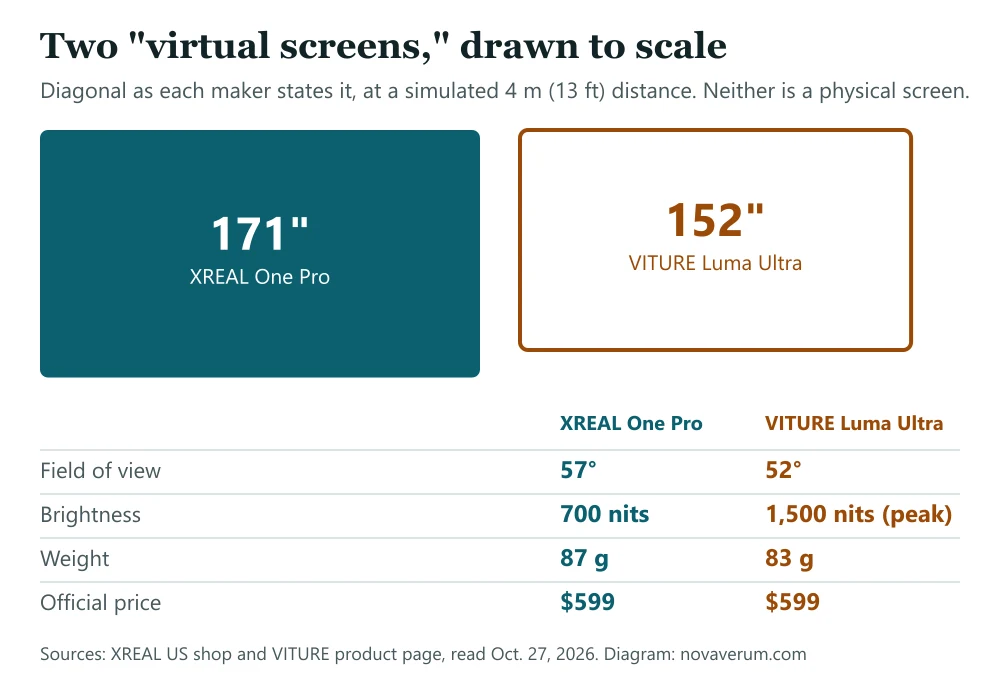
On paper they are close. Both cost $599 on the makers' U.S. pages, both use Sony micro-OLED panels at up to 120 Hz and both weigh in the mid-80s of grams. The table lists what each maker says.
| Spec | XREAL One Pro | VITURE Luma Ultra |
|---|---|---|
| Price | $599 (crossed-out $649) | $599 |
| Virtual screen | Up to 171 inches at 4 m | 152 inches at a simulated 4 m |
| Field of view | 57° | 52° |
| Display | Sony 0.55-inch micro-OLED, 1080p, 120 Hz | Sony micro-OLED, 1200p, up to 120 Hz |
| Brightness | 700 nits | 1,500 nits peak |
| Weight | 87 g | 83 g |
| Lens dimming | Three electrochromic levels | Electrochromic, 0.5% to 40% transmittance |
| Cameras | None built in; XREAL Eye is a $99 add-on | One RGB camera and two depth cameras built in |
| Sound | Bose-tuned speakers | HARMAN speakers |
XREAL One Pro and VITURE Luma Ultra as listed on the makers' U.S. pages on Oct. 27, 2026.
XREAL's shop lists two sizes, M for pupil distances of 57 to 66 mm and L for 66 to 75 mm. VITURE's Luma Ultra page lists one size for 58 to 70 mm, and its built-in focus adjustment goes up to -4.0D for nearsighted users.
What does a 171-inch virtual screen really mean?
It is a comparison, not a size you can measure. XREAL's note says the number "represents the screen size equivalent to a projection from a 4-meter distance," and VITURE writes the same thing as a "simulated 4m distance." A 171-inch diagonal at about 13 feet is how big the picture looks to you, not how much room the glasses take up. The field of view, 57 degrees on the One Pro and 52 on the Luma Ultra, is the better clue: it says how much of your view the image fills.
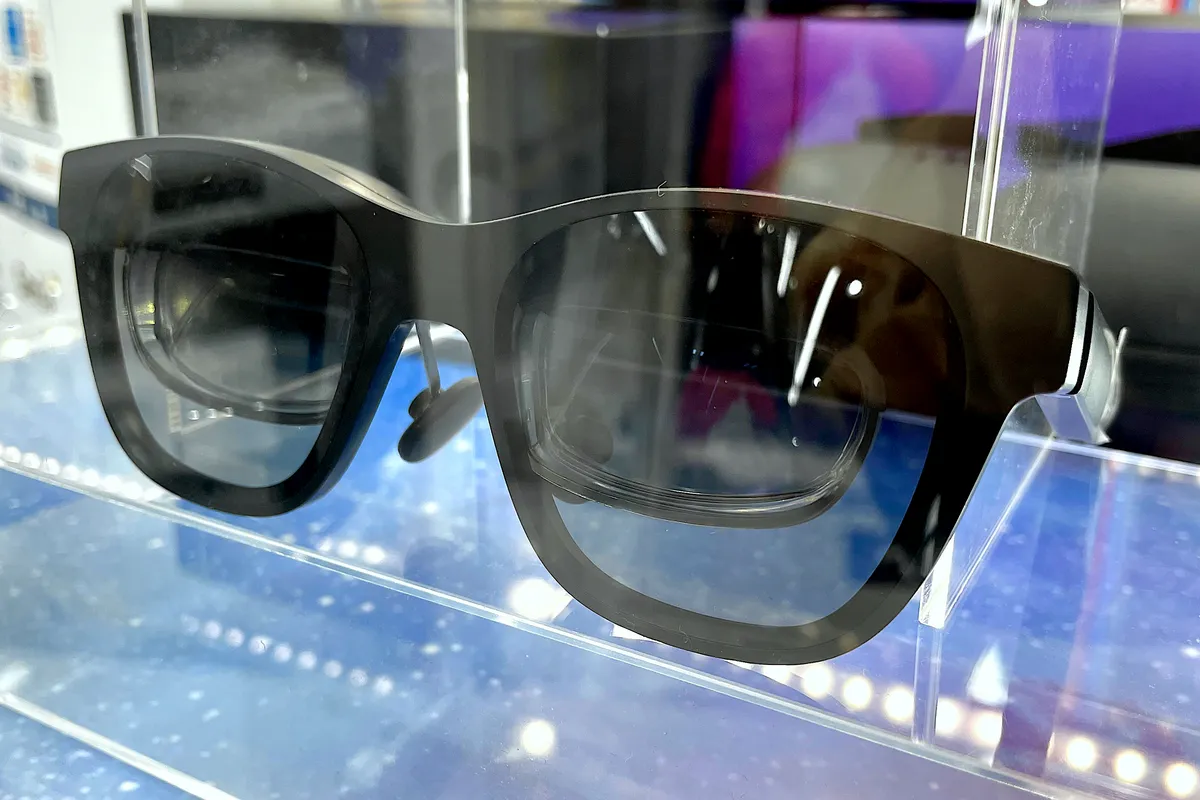
The resolution is the other limit. XREAL's One Pro is 1080p, and TechRadar's Hamish Hector noted the image is "still only 1080p (full HD) rather than 4K," while saying it looks "pretty darn good" at 120 Hz. VITURE lists 1200p for the Luma Ultra.
What do you need to connect them?
A device that sends video out over its USB-C port. XREAL's page puts it this way: "The device must have a USB-C DP port and support DP output." Check your own model before you buy, because not every USB-C port carries video.
XREAL's shop lists these as compatible with the One Pro:
- iPhone 15, 16 and 17 series, which have USB-C
- Android phones that support DisplayPort output
- Steam Deck and Steam Deck OLED, and the ASUS ROG Ally
- MacBooks and Windows laptops
Anything that outputs only HDMI, including an iPhone 14 or older, needs an adapter or XREAL's Beam device. The Nintendo Switch needs the XREAL Hub, listed at $39.99. In the box you get the glasses, a USB-C to USB-C cable, nose pads, a case, a cleaning cloth and a frame for prescription lenses, which are sold separately.
VITURE's Luma Ultra connects through an included 1.2-meter USB-C to magnetic connector cable and has no built-in battery, so it draws power from the connected device. VITURE lists Steam Deck, ROG Ally, Legion Go and other handhelds, plus Windows and Mac computers, and says the Switch and Switch 2 work through its Mobile Dock Mini, Pro Mobile Dock or USB-C XR Charging Adapter Ultra, all sold separately.
Can you use AR glasses on a plane?
XREAL markets the One Pro for it. Its page says the stabilized screen is "perfect for traveling and commuting by plane, train and car," and its "Follow" mode keeps the screen aligned with your gaze, which XREAL recommends for travel because it reduces motion sickness. TechRadar's reviewer wrote that "if I'm ever traveling with a pair of smart glasses again, it'll be these," and added that for trips you will want headphones, both to cut outside noise and to keep the glasses' speakers from bothering neighbors.
VITURE's Luma Ultra page does not mention flights. I found no airline policy on either maker's page, so confirm with your airline what electronics you can use in flight.
How do the screens stay in place when you move your head?
That is called tracking, and it is where the two pairs differ most. With 3DoF, the screen stays fixed in space when you turn your head. With 6DoF, it also stays put when you lean or walk.
XREAL's One Pro has its own chip, the X1, that handles 3DoF without an app, adapter or extra software. For 6DoF you add the XREAL Eye camera, listed at $99. VITURE's Luma Ultra has the cameras built in, but VITURE says 6DoF works only through its SpaceWalker app on a Mac or Windows computer, or with its Pro Neckband. On Android and iPhone it offers 3DoF, and on iPhone that needs the USB-C XR Charging Adapter Ultra or the Mobile Dock Mini.
Android Central's Nicholas Sutrich wrote in December 2025 that "Luma Ultra still doesn't do as much natively as Xreal One," and that the XREAL glasses with the Eye can do 6DoF "with any device that outputs video, no software required." The same review said VITURE's SpaceWalker app is "substantially more full-featured" and that its Pro Mobile Dock made it possible to use the glasses with a Switch 2, "something no other smart glasses brand can claim." Those statements are from that date; XREAL's page lists the Switch with its Hub and does not mention the Switch 2.
What did reviewers find?
Both reviewers I read liked the XREAL One Pro's picture and noted its price. TechRadar called it "the best AR smart glasses for entertainment," citing the Bose audio and the larger image, with cons of "Expensive" and "Requires other devices." Tom's Hardware tested it with an iPhone 16 Pro, a 14-inch MacBook Pro and a Lenovo Legion Go S, and found text easy to read for long periods. It added that the darkest lens setting "doesn't completely block out all environmental light" and that the picture from the optional Eye camera was poor.
For the Luma Ultra, Android Central called it the best pair VITURE has made, but headlined its review "admittedly a little disappointing for now" because the spatial features did less on their own than XREAL's, with more spatial content promised. Its closing advice: "If you want easy plug-and-play spatial tracking that works with any device, Xreal One or Xreal One Pro are the best picks. If you want broader ecosystem compatibility and more power-user settings for features like 3D video or multi-monitor support, Viture Pro or Ultra are great choices."
The reviews are from June and December 2025, before the prices on the makers' pages today, so read them for how the glasses behave, not for what they cost now.
How much do they cost?
On October 27, 2026, XREAL's U.S. shop listed the One Pro at $599, next to a crossed-out $649. TechRadar gave $649 as the launch price in June 2025, and Tom's Hardware said it was $599 in pre-order and $649 afterward. The shop also listed the XREAL 1S at $449 and the older XREAL One at $399. Prescription lenses for the One Pro started at $59.90, down from $159.90, in the shop. XREAL lists 30-day returns and a one-year warranty.
VITURE's page listed the Luma Ultra at $599, with free shipping in the U.S. and free 30-day returns. Its home page also listed the Luma Pro at $499, the Luma at $399 and the Pro 2 at $299. The Luma Ultra's page says the Luma Pro has the same 152-inch display at 1,000 nits and no cameras.
Adapters, docks and cameras are extra on both sides, and prices on these stores move with sales. Check the live page before you decide.
Are AR glasses worth it as a portable monitor?
They make sense if the problem is a screen that is too small or too public: a laptop on a train, a handheld in bed, a movie on a long trip. For that job the XREAL One Pro is the simpler plug-in, and the VITURE Luma Ultra fits better if you want multiple screens, 3D conversion or a Switch dock. They do not replace a good monitor at a desk, and VITURE suggests a wearing time of three to four hours at a stretch. The cameras and chips are extras that matter only if you will use spatial features.
Like the other products in our guides, they pass the basic checks from our guide to spotting a fake gadget video: official pages with prices, listed specs and independent reviewers who reported what did not work. If a bigger screen in your pocket is your goal, the folding phones in our guide to tri-fold phones are the other way to get one.
Frequently asked questions
Can AR glasses work as a monitor for a laptop?
Yes. XREAL lists MacBooks and Windows laptops as compatible with the One Pro, and VITURE says the Luma Ultra works with Windows and Mac computers. The laptop must output video over USB-C.
Do XREAL and VITURE glasses work with an iPhone?
XREAL lists the iPhone 15, 16 and 17 series, which have USB-C. An iPhone 14 or older needs an adapter or the XREAL Beam. VITURE says the Luma Ultra works with iOS for 3DoF through its USB-C XR Charging Adapter Ultra or Mobile Dock Mini.
Can you use AR glasses on a plane?
XREAL says its One Pro is "perfect for traveling and commuting by plane, train and car," and TechRadar recommends headphones for trips. VITURE's Luma Ultra page does not mention flights. I found no airline rule on either maker's page.
Do XREAL and VITURE glasses work with a Nintendo Switch?
XREAL says the Switch needs its XREAL Hub, listed at $39.99. VITURE says the Switch and Switch 2 work through its Mobile Dock Mini, Pro Mobile Dock or USB-C XR Charging Adapter Ultra, sold separately.
How big is a 171-inch virtual screen?
It is how big the picture looks, not a physical size. XREAL says the number is equivalent to a projection from 4 meters away, and VITURE gives 152 inches at a simulated 4 meters. The field of view, 57 and 52 degrees, shows how much of your view the picture fills.
Can you wear AR glasses with a prescription?
Both makers say yes. XREAL includes a frame for prescription lenses in the One Pro box and sells the lenses separately, from $59.90 in its shop on Oct. 27, 2026. VITURE builds in an adjustment for nearsightedness up to -4.0D and sells a prescription lens frame as an accessory.
Which costs more, the XREAL One Pro or the VITURE Luma Ultra?
Both were $599 on the makers' U.S. pages on October 27, 2026. XREAL's page also showed a crossed-out $649, and docks, adapters and cameras are extra for both.
Sources
- XREAL U.S. shop: XREAL One Pro (price, specifications, compatibility, returns), read Oct. 27, 2026
- XREAL: One Pro product page (DisplayPort requirement, Switch, travel), read Oct. 27, 2026
- XREAL U.S. shop: XREAL 1S, read Oct. 27, 2026
- VITURE: Luma Ultra XR/AR Glasses (price, specifications, compatibility, returns), read Oct. 27, 2026
- VITURE: home page (Luma Pro, Luma and Pro 2 prices), read Oct. 27, 2026
- TechRadar: Xreal One Pro review (Hamish Hector, June 18, 2025)
- Tom's Hardware: Xreal One Pro review (June 18, 2025)
- Android Central: Viture Luma Ultra hands-on (Nicholas Sutrich, Dec. 10, 2025)

Founder and editor, Novaverum
I write Novaverum to separate the technology you can really buy from the demos, concepts and viral fakes, starting from what the companies, regulators and engineers publish. Every article lists its sources at the end.