Home & Robots
Self-Emptying Robot Vacuums: What the Dock Does and What It Costs
Quick answer
A self-emptying dock lets a robot vacuum empty its own bin into a sealed bag, so you handle a bag every 7 to 13 weeks, by the makers' longest claims, instead of a bin after every run. On the U.S. sites I read on Nov. 5, 2026, robots with such a dock ran from $269.99 at iRobot to $1,599.99 at Roborock, and replacement bags cost about $4 to $6 each.
On this page
A self-emptying robot vacuum takes over a chore most owners forget they signed up for: carrying the dust bin to the trash after every run. The dock pulls the dirt out of the robot and moves it into a sealed bag, and the pricier docks also wash and dry the mop. The sales pages say how many weeks that saves you. They say less about what the dock adds to the price and what the bags cost afterward.
This guide covers what a dock does, how the three kinds differ, what the makers claim about bag life and what I found on the U.S. sites of iRobot, Roborock and Eufy on Nov. 5, 2026. Prices come from those pages, are in U.S. dollars and change often.
What does a self-emptying robot vacuum dock do?
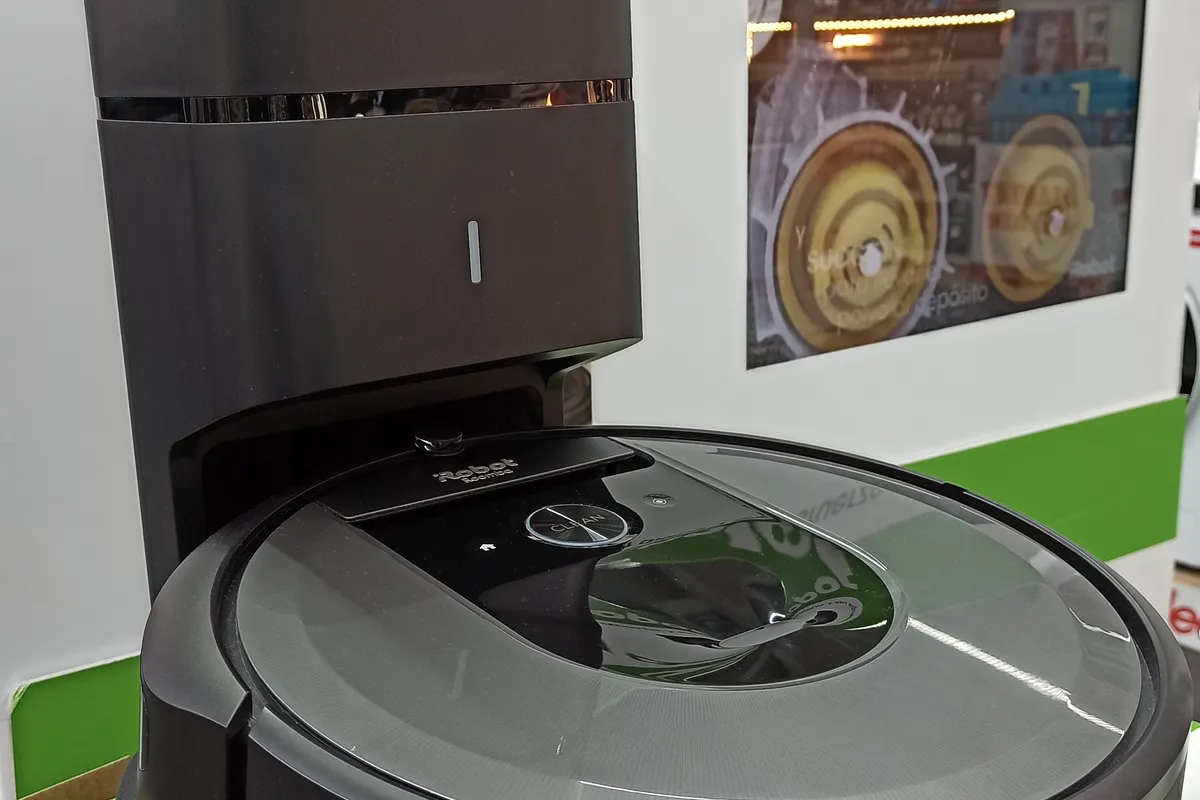
A robot vacuum carries a small dust bin, and on a normal model you empty it yourself. On a self-emptying model the robot rolls back to its dock after cleaning, and the dock empties the bin into a bag stored inside the dock. You deal with that bag every few weeks, not the bin every day.
Each maker publishes its own "up to" figure for how long the bag lasts. Eufy's page says dust and debris is "automatically sealed in a 3L bag, ensuring hands-free cleaning for up to 75 days." iRobot says the dock on its Roomba Plus 575 Combo "automatically empties debris for up to 3 months of hands-free cleaning." Roborock says the dock on its Qrevo Curv "allows for up to 7 weeks without emptying."
What are the three kinds of docks?
Across the three brands, docks come in three steps, and the step explains most of the price gap.
Empty only. The dock empties the bin and charges the robot. The cheapest example I found is iRobot's Roomba 105 Combo Robot + AutoEmpty Dock at $269.99, listed as reduced from $469.99. I read only that listing, not the product page, so I cannot say more than what the name says.
Empty, wash and dry. The dock also cleans the mop and refills the robot's water tank. iRobot says its AutoWash Dock on the Plus 575 Combo washes the mop pads at 75 °C (167 °F), hot-air dries them at 45 °C (113 °F) and refills the tank "for up to 40 days of mopping." Roborock lists the same two temperatures for the Qrevo Curv, plus automatic tank refilling. Eufy's Omni C28 page lists five jobs for its station: self-cleaning mop, hot-air drying, dust emptying, tank refilling and wastewater collection, with drying at 35 to 50 °C (95 to 122 °F).
Everything, including detergent. The top tier adds automatic soap. Roborock's FAQ says the Saros 20 dock supports hot-water mop washing at 100 °C (212 °F), warm-air drying at 55 °C (131 °F), automatic detergent dispensing, auto-emptying, automatic water refilling and self-cleaning, and adds that a dust-bag drying system prevents moisture buildup and odors. Eufy's Omni E28 has the same list as the C28, with detergent dispensing that "lasts up to 6 months."
How long does a dust bag last?
By the makers' own claims, between about 7 weeks and 90 days. The diagram draws the three figures to scale and shows what one bag costs.
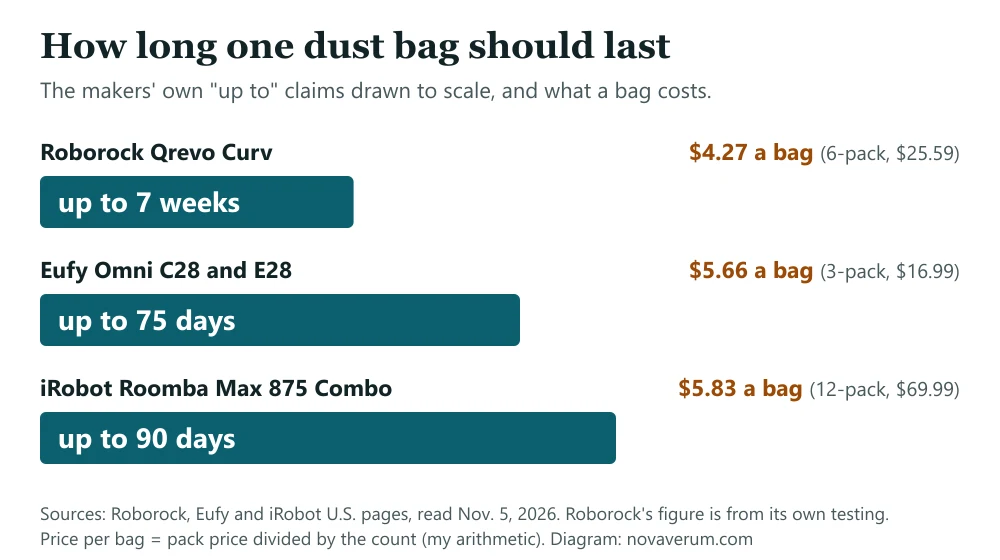
Every one of these is a best case. Roborock's page ties its 7 weeks to the maker's own testing and says actual intervals depend on how you use the robot and on the environment. A home with a long-haired pet or a lot of carpet will fill a bag faster, so I would plan on the shorter end.
How much does a self-emptying robot vacuum cost?
From $269.99 to $1,599.99 on the pages I read. The table lists the models whose dock I could read about, with the price shown next to the buy button on Nov. 5, 2026.
| Robot and dock | Price on the page | What the dock does | Bag interval claimed |
|---|---|---|---|
| iRobot Roomba 105 Combo + AutoEmpty Dock | $269.99 (listed as reduced from $469.99) | Empties the robot (by its name; product page not read) | Not read |
| iRobot Roomba Plus 575 Combo + AutoWash Dock | $499.99 (reduced from $799.99; offer ends Nov. 7) | Empties, washes and dries the mop pads, refills the tank | Up to 3 months |
| iRobot Roomba Max 875 Combo + AutoWash Dock | $1,199.99 | Empties into a carbon AllergenLock bag, washes the roller at 80 °C (176 °F), dries it at 55 °C (131 °F) | Up to 90 days |
| Eufy Omni C28 | $799.99 | Washes and dries the mop, empties, refills the tank, collects the dirty water | Up to 75 days |
| Eufy Omni E28 | $1,099.99 | Same as the C28, plus automatic detergent | Up to 75 days |
| Roborock Qrevo Curv | $849.99 (page also shows $1,599.99; marked sold out) | Empties, washes the mop at 75 °C (167 °F), dries it at 45 °C (113 °F), refills the tank | Up to 7 weeks |
| Roborock Saros 20 | $1,599.99 | Empties, washes at 100 °C (212 °F), dries at 55 °C (131 °F), dispenses detergent, refills, cleans itself | Not stated |
Robots with a self-emptying dock, as shown on the makers' U.S. pages on Nov. 5, 2026.
Treat the table as a snapshot. Roborock's Qrevo Curv page showed "Sold Out" and "Out of stock, coming soon!", and the Saros 20 page showed both "Add to Cart" and an out-of-stock message, so check that one is really in stock before you commit to either. On Eufy's site the collection page showed lower prices than the product pages, for example $459.99 against $799.99 for the C28, and I could not tell which one the cart would charge. Roborock's U.S. collection page carried a banner saying its Black Friday sale starts Nov. 19, and iRobot's $300 offer on the Plus 575 Combo ends on Nov. 7.
On the iRobot and Roborock U.S. pages I found no dock sold on its own. The dock's share of the price is not published, and you pay for it inside the bundle.
What do the bags and refills cost?
About $4 to $6 per bag. Roborock sells a 6-pack at $25.59, or $4.27 a bag. Eufy's 3-pack was $16.99 on its product page, or about $5.66 a bag. iRobot sells a 12-pack at $69.99, about $5.83 a bag, and a 3-pack at $19.99, about $6.66 a bag. If a bag lasted as long as each maker's longest claim, a year would take roughly 4 to 7 bags, or about $24 to $32. That is my arithmetic from the claims, not a figure from the makers.
Bags are not universal, so check the match before you buy a pack. Roborock's bag page names the Qrevo, Qrevo Curv, Qrevo Edge and Saros series, while a second Roborock bag listing names older models such as the S8 Pro Ultra and does not name the Saros or the Qrevo Curv. iRobot's 12-pack page lists Clean Base models in the i, s, j and Essential series and the AutoWash dock for the Roomba Combo 10 Max, and it does not name the Max 875 Combo or the Plus 575 Combo. Eufy's 3-pack title names the E35, C30, C28, E25 and E28, while the compatibility bullet names the E28, E25, E20 and C28.
The wash docks add one more regular purchase, the cleaning solution. Roborock sells a 480 ml bottle of floor cleaning solution at $18.99, and Eufy says the detergent on the E28 lasts up to 6 months.
What do the return and warranty terms say?
All three let you try the robot at home. iRobot's product pages say "60-day home trial" and "Free shipping & returns on all robots." Roborock offers a return or replacement "for any reason in 30 days of delivery" and lists a 1-year limited warranty. Eufy's policy says "Undamaged products can be returned for a full refund, regardless of the reason, within 30 days of purchase," and lists 12 months of warranty for its RoboVac line.
Whether the bag interval holds is something only your own floors can answer, and I would use that window to find out: run the robot as you normally would and note how soon the dock asks for a new bag.
Is a self-emptying dock worth it?
The empty step is the part that earns the dock. Skipping the daily bin, with a bag to handle every month or two, is the convenience all three brands sell, and the pages back it with specific figures. The wash tier is worth the step up if you mop often, because it also cleans and dries the pads for you, and the detergent tier fits a house where the mop runs most days.
My read: if I had to pick one upgrade, I would take the emptying dock first and add the wash tier only if the mop is part of the weekly routine. The arm that lifts socks is a different kind of upgrade, and I cover it in my guide to robot vacuums with arms. Other robots that do a chore on their own are in my guides to window-cleaning robots and the wire-free robot lawn mower, and the bigger household machines are in my guide to humanoid home robots.
Frequently asked questions
What does a self-emptying robot vacuum dock do?
It empties the robot's dust bin into a sealed bag inside the dock after a run, so you handle a bag every few weeks instead of a bin every day. Pricier docks also wash and dry the mop and refill the water tank.
How often do you have to empty a self-emptying robot vacuum dock?
The makers claim up to 7 weeks (Roborock Qrevo Curv), up to 75 days (Eufy Omni C28 and E28) and up to 3 months or 90 days (iRobot Roomba Plus 575 and Max 875). Roborock says its figure comes from its own testing and depends on use and environment.
How much does a self-emptying robot vacuum cost?
On iRobot's, Roborock's and Eufy's U.S. pages on Nov. 5, 2026, prices ran from $269.99 for iRobot's Roomba 105 Combo with an AutoEmpty dock to $1,599.99 for Roborock's Saros 20. Prices were moving ahead of Black Friday, so check the live page.
Do you have to keep buying dust bags for a self-emptying robot vacuum?
Yes. The dock stores the dirt in a replaceable bag. The packs I found cost about $4 to $6 a bag: $25.59 for 6 from Roborock, $16.99 for 3 from Eufy and $69.99 for 12 from iRobot.
Can I use any dust bag in any self-emptying dock?
No. Each maker's bag page lists the models it fits, and the lists differ. iRobot's 12-pack page does not name the Max 875 Combo or the Plus 575 Combo, so check your model before you buy a pack.
Does a self-emptying dock also wash the mop?
Some do. iRobot's AutoWash, Roborock's multifunctional docks and Eufy's Omni stations wash and dry the mop. iRobot's AutoEmpty dock, as its name says, empties the robot.
Can I buy a self-emptying dock on its own?
I found no dock sold on its own on the iRobot or Roborock U.S. pages I read, so the dock's share of the price is not published. You pay for it as part of the robot bundle.
Is a self-emptying robot vacuum worth it?
The emptying step is what the dock is for, and all three brands let you test it at home: iRobot gives a 60-day home trial, and Roborock and Eufy give 30 days. The wash and detergent tiers make sense if you mop often.
Sources
- iRobot U.S.: Roomba Plus 575 Combo robot + AutoWash dock (price, dock, home trial), read Nov. 5, 2026
- iRobot U.S.: Roomba Max 875 Combo robot + AutoWash dock, read Nov. 5, 2026
- iRobot U.S.: Roomba robots listing (Roomba 105 Combo + AutoEmpty Dock price), read Nov. 5, 2026
- iRobot U.S.: Replacement Dirt Disposal Bags, 12-Pack (price and compatibility), read Nov. 5, 2026
- Roborock U.S.: Qrevo Curv with Multifunctional Dock 3.0 (price, dock, returns), read Nov. 5, 2026
- Roborock U.S.: Saros 20 (price and dock FAQ), read Nov. 5, 2026
- Roborock U.S.: Dust Bag, 6 pcs (price and compatibility), read Nov. 5, 2026
- Eufy U.S.: Robot Vacuum Omni C28 (price, station, bag interval), read Nov. 5, 2026
- Eufy U.S.: Robot Vacuum Omni E28 (price, station, detergent), read Nov. 5, 2026
- Eufy U.S.: Dust Bag, 3 pieces (price and compatibility), read Nov. 5, 2026
- Eufy U.S.: refund and warranty policy, read Nov. 5, 2026

Founder and editor, Novaverum
I write Novaverum to separate the technology you can really buy from the demos, concepts and viral fakes, starting from what the companies, regulators and engineers publish. Every article lists its sources at the end.