Home & Robots
Window-Cleaning Robots: How They Stick to Glass
Quick answer
A window-cleaning robot sticks to glass with suction: a fan or pump pulls air out from under its body, so the air outside presses it against the window, and a safety rope stands by as backup. Ecovacs sells models from $170 to $699.99 that stay on the glass for at least 30 minutes on backup power. They suit smooth, flat glass.
On this page
- How does a window-cleaning robot stick to glass?
- How does the robot move and clean?
- What happens if the power goes out?
- Do you really need the safety rope?
- Which windows can a window-cleaning robot clean?
- How much does a window-cleaning robot cost?
- How well do they actually clean?
- Is this a real product or another viral gadget?
- FAQ
- Sources
A robot that walks up a window and cleans it sounds like the kind of gadget that only exists in a trade-show video. It does exist. Several companies sell one, and the part that surprises people is not the cleaning. It is how the robot stays on the glass without falling.
This guide explains the physics in plain words, what the safety systems do, which windows work and what the main models cost. Figures come from the makers' own pages and one independent review, each listed with its date at the end.
How does a window-cleaning robot stick to glass?
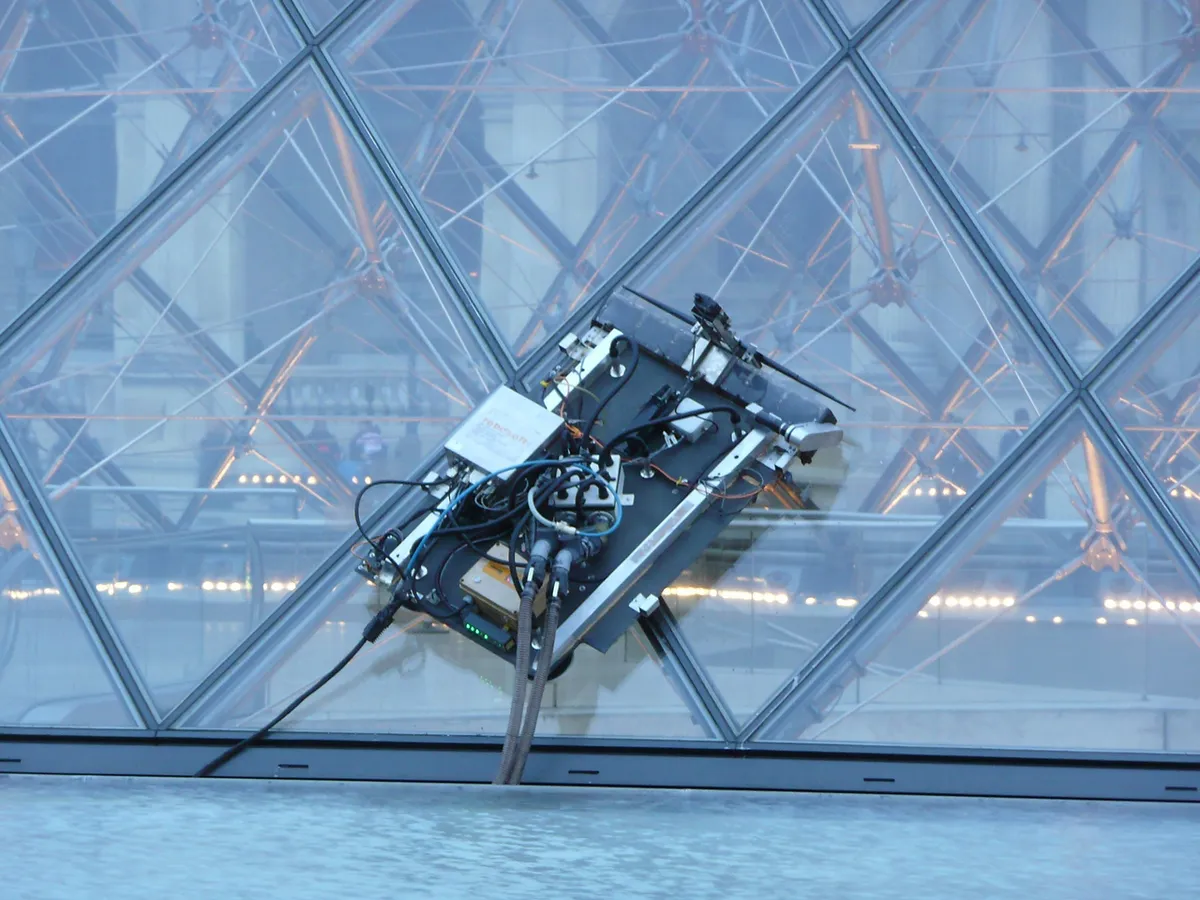
With suction. Ecovacs, one of the main sellers in the U.S., says its robots use suction "to attach securely to the glass." A fan or pump inside the robot pulls air out from the space between its body and the window. The pressure under the robot drops, the air outside is now pushing harder than the air beneath, and that difference presses the machine against the pane.
Hobot, another maker, describes the same idea on its S7 Pro page: a "high volume centrifugal pump" that keeps the negative pressure steady, which it says helps the robot cope with small air leaks. It lists 4,800 Pa of suction. Ecovacs gives its own figures in pascals too: the W2S Omni is listed at 8,000 Pa maximum and 3,000 Pa while moving.
A seal matters as much as the fan. In a review for TechRadar, Ruth Hamilton writes that the mop pads are "helping to form a seal around the suction area," which sits near the middle of the underside. That is why Ecovacs asks for smooth glass without cracks, and why Hobot stresses a pump that can cope with small leaks. Ecovacs also lists "auto air pressure compensation" among the hardware measures it uses against falls.
How does the robot move and clean?
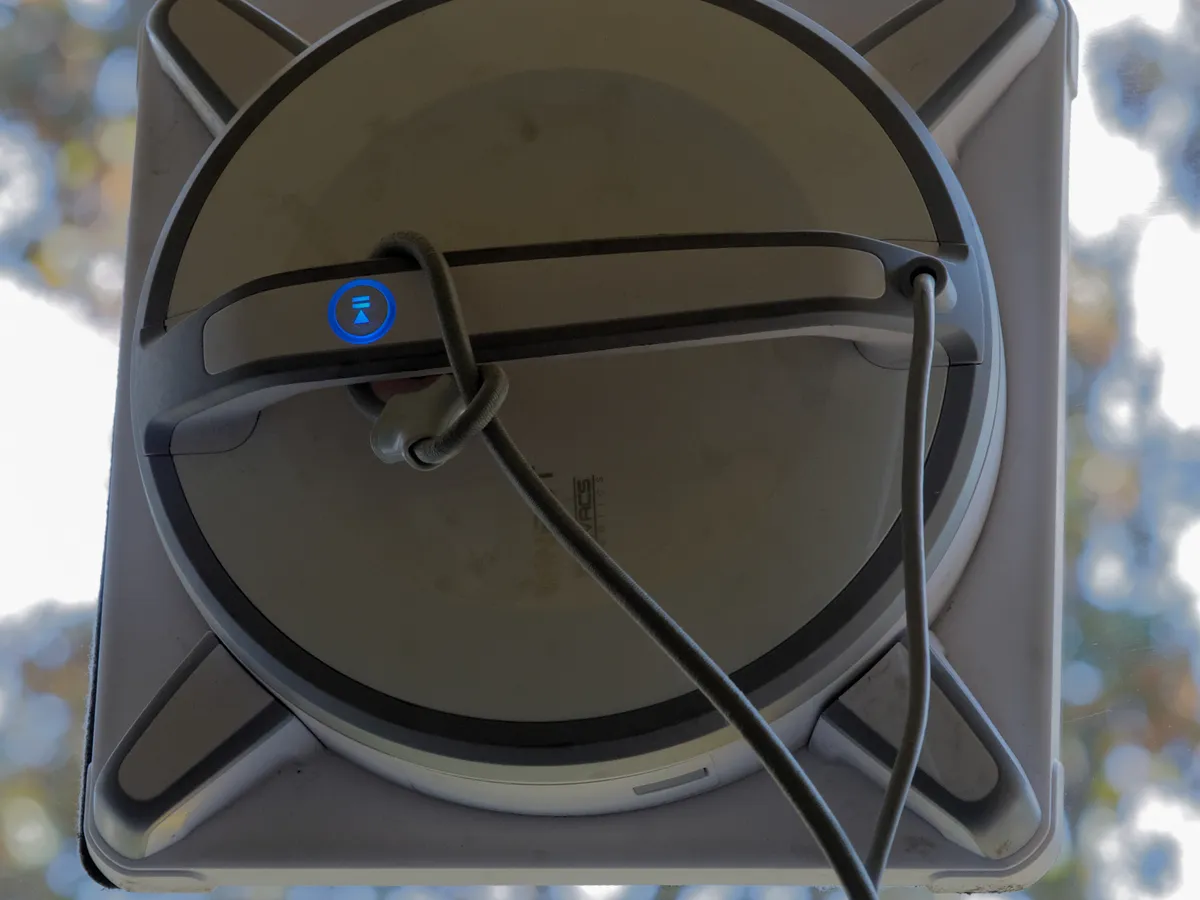
Once it is stuck, the robot drives itself across the glass. According to TechRadar, these machines typically spray a light mix of water and cleaning solution ahead of them, and their mop pads vibrate to buff off the dirt. It is a relatively dry setup, with no suds.
The Ecovacs W3 Omni page gives a sense of speed: 16 cm/s, and about 1 minute 35 seconds, give or take 15 seconds, for a 1 m by 1 m test patch in its fast mode. On the edges, the Ecovacs pages describe a gravity sensor that detects slipping and an edge sensor that spots the end of the glass.
What happens if the power goes out?
This is the question most buyers ask first, and the makers have an answer. Ecovacs says its robots keep a backup battery that holds them on the window for more than 30 minutes if the main battery runs low, and the mini lists 30 minutes of "power-off protection" with an alarm. Hobot's S7 Pro has a built-in UPS, an uninterruptible power supply, that keeps it in place for 20 minutes with a continuous audio alert, according to its page.
Think of that window as time to walk over and take the robot off the glass. It is not permission to leave. Hobot adds that its S7 Pro stays wired while it works, with a 4 m power cord that can be extended to 8 m. TechRadar notes that most window bots run from the mains to keep the weight down.
Do you really need the safety rope?
The makers say yes, and so does the one reviewer who skipped it. In her TechRadar piece, Hamilton writes that she was so confident in the robot's grip that she stopped attaching the cable. One morning it "simply dropped off the window with no warning." It was on the outside of a third-floor window. She caught the rope and no damage was done, and she says it happened only once, but she advises always attaching the rope and watching the robot where a fall could hurt someone.
Ropes differ by model. Ecovacs lists a three-layer composite cable rated to 100 kg of tensile strength on the W2S Omni and W3 Omni, plus a 1 m backup rope on the station. The mini has a 3.3 m nylon and latex rope rated to at least 1,900 N. Hobot's S7 Pro has a 4.5 m rope that it says can bear up to 230 kgf.
Which windows can a window-cleaning robot clean?
Flat, smooth glass is the safe answer. Ecovacs says the glass should be free of decals, stickers and cracks, and should not be too small, curved or irregularly shaped. It also lists condensation and oil stains as problems, and says not to use the robot in extremely hot or cold conditions.
The product pages add numbers. The W2S Omni and W2S Pro list a minimum window size of 30 by 40 cm, and the mini goes down to 22 by 25 cm. Minimum glass thickness is 3 mm on the W2S Omni, mini and W3 Omni pages. Ecovacs says its robots handle windows up to 8 m wide by 2.5 m high.
Frameless glass is the case that worries people most, since there is no frame to stop the robot. Ecovacs lists the W2S Omni for flat windows "with or without frames," and the mini and W2S Pro for both framed and frameless glass. Both makers use sensors to detect an open edge. Hobot calls its version Edge-Leakage-Bumper (ELB) sensors, and says they detect air leaking at gaps between frameless panels.
How much does a window-cleaning robot cost?
On Ecovacs's U.S. store, single robots run from $170 to $699.99. The table shows the four models listed with a price on October 21, 2026. Bundles with accessories cost more, and the older W2 Omni page showed as sold out. Hobot's S7 Pro page lists no price.
| Model | Price | Backup hold time | Safety rope |
|---|---|---|---|
| WINBOT mini | $170.00 | 30 min | 3.3 m |
| WINBOT W2S PRO | $399.99 | 30+ min | Not listed |
| WINBOT W2S OMNI | $599.99 | 30+ min | Rated 100 kg |
| WINBOT W3 OMNI | $699.99 | 30+ min | Rated 100 kg |
Ecovacs WINBOT models listed with a price on the company's U.S. store, as read on Oct. 21, 2026. Backup hold time is how long the page says the robot stays on the glass on backup power.
Prices on these stores move with sales. Check the live page before you plan around a number.
How well do they actually clean?
Better than nothing, with limits. TechRadar's tester says her Hobot S7 Pro did "a pretty good job of clearing away surface dirt" but left visible track marks where it pivoted, while a colleague who tested an Ecovacs model had good things to say about its cleaning. The cleaning is gentle and uses little water, so the review says these robots are for surface dirt, not bird droppings or mud splashes.
You also stay in the loop. You place the robot on each pane, switch it on and move it when it finishes, so it is a time saver, not a hands-off chore. Its main advantage is reach: Hamilton's robot slipped behind protective railings that would be a challenge for a person to reach.
Is this a real product or another viral gadget?
Real, and a useful contrast with the laundry-folding robot we looked at in why you can't buy a laundry-folding machine yet. These robots pass the checks in our guide to spotting a fake gadget video: there are official pages with prices, specifications you can compare, and an independent journalist who tested one and reported a failure along with the good parts.
The honest summary is a narrow tool that does one job on flat glass, with a rope and a human nearby. That is the reason it works as a product today while bigger home-robot ideas are still prototypes.
Frequently asked questions
How does a window-cleaning robot stay on the glass?
It uses suction. A fan or pump pulls air out from under the robot, and the higher pressure of the air outside holds it against the pane. Ecovacs says its robots use suction to attach securely to the glass.
What happens if the power goes out?
Ecovacs says its robots stay attached for more than 30 minutes on backup power, and Hobot says its S7 Pro stays in place for 20 minutes with an audio alert. Both advise attaching the safety rope.
Do window-cleaning robots work on frameless glass?
The makers say yes. Ecovacs lists the mini and W2S Pro for framed and frameless windows, and Hobot uses edge-leakage sensors for frameless panels. Hobot and Ecovacs both give these as company claims.
How much does a window-cleaning robot cost?
On Ecovacs's U.S. store, single robots were listed from $170 (WINBOT mini) to $699.99 (WINBOT W3 OMNI) on October 21, 2026. Hobot's S7 Pro page lists no price.
Can I leave a window-cleaning robot alone?
Not safely. The makers supply a safety rope, and a TechRadar reviewer reports that her robot once dropped off a third-floor window when she skipped it. You also have to move the robot from pane to pane.
Do window-cleaning robots clean as well as a person?
They handle surface dirt. A TechRadar review found good results on light dirt but visible track marks where the robot pivoted, and says they are not meant for bird droppings or mud.
Sources
- Ecovacs U.S.: WINBOT window cleaning robots (FAQ and safety), read Oct. 21, 2026
- Ecovacs U.S.: Shop window cleaning robots (prices), read Oct. 21, 2026
- Ecovacs U.S.: WINBOT mini, read Oct. 21, 2026
- Ecovacs U.S.: WINBOT W2S PRO, read Oct. 21, 2026
- Ecovacs U.S.: WINBOT W2S OMNI, read Oct. 21, 2026
- Ecovacs U.S.: WINBOT W3 OMNI, read Oct. 21, 2026
- HOBOT: HOBOT-S7 Pro, read Oct. 21, 2026
- TechRadar: Are robot window cleaners any good? I tested one (Ruth Hamilton, Jan. 25, 2026)

Founder and editor, Novaverum
I write Novaverum to separate the technology you can really buy from the demos, concepts and viral fakes, starting from what the companies, regulators and engineers publish. Every article lists its sources at the end.