Home & Robots
How Do Robot Lawn Mowers Without Wires Find the Edge of the Lawn?
Quick answer
A wire-free robot mower keeps your lawn boundary as a map saved in an app, then works out where it is on that map in real time. It does that with satellite positioning (RTK), laser scanning (LiDAR), cameras, or a mix. U.S. maker pages list models from $669 to $4,299.99. Thick tree cover is the main weak spot for satellite-only models.
On this page
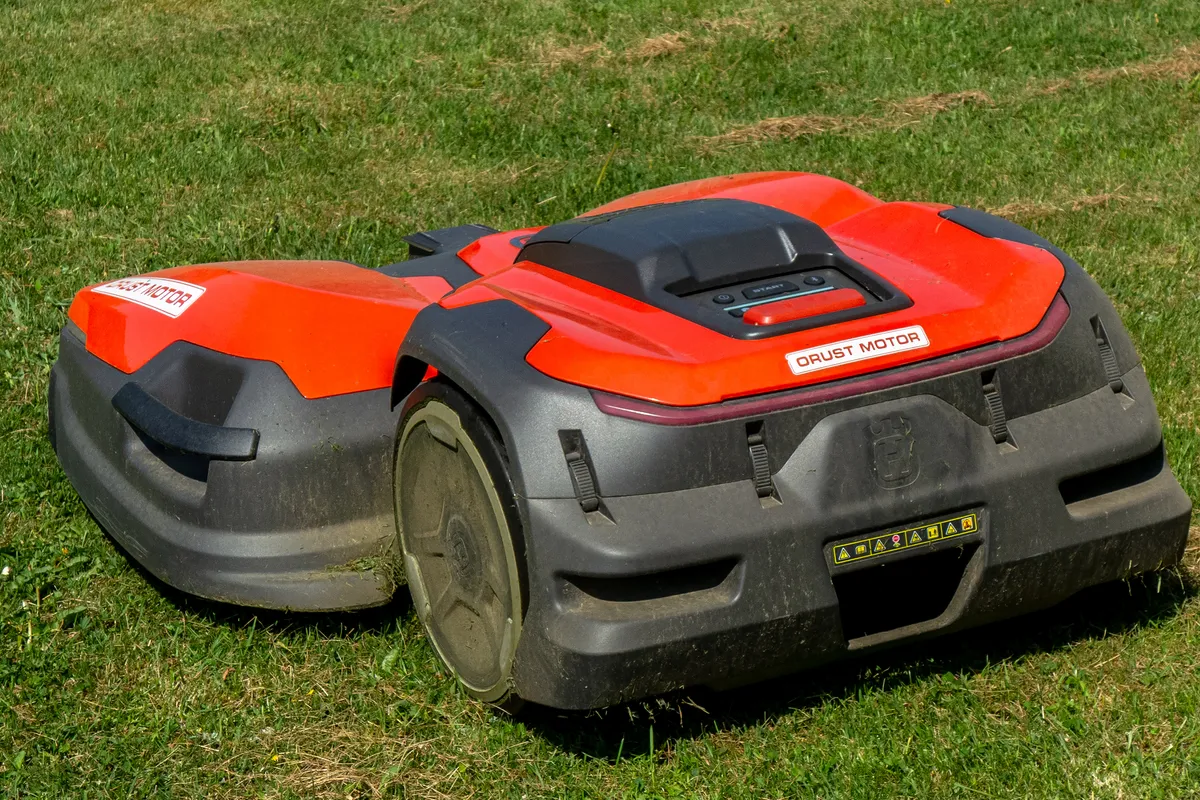
The first robot mowers needed a wire. You pushed a thin cable into the ground around the lawn, and the mower turned around whenever it sensed the signal. The new generation has no wire at all, so the obvious question is how it knows where the grass ends and the flower bed, the driveway or the neighbor's yard begins.
The short version: you draw the edge once, and the mower spends every mowing session working out where it is. This guide covers how that works, where it can fail and what the models cost. Every figure comes from a maker's page, listed with its date at the end.
What does "no wire" actually mean?
It means the boundary lives in software. Husqvarna's setup guide for its Automower iQ series has you drive the mower around the lawn with the app to set virtual boundaries, then mark mowing areas and stay-out zones. Mammotion says you only need to create a map of your lawn, either manually or automatically in the app, and mowing can start right away. Navimow describes a one-tap Auto Mapping on its X4 and an editable map of the real scene.
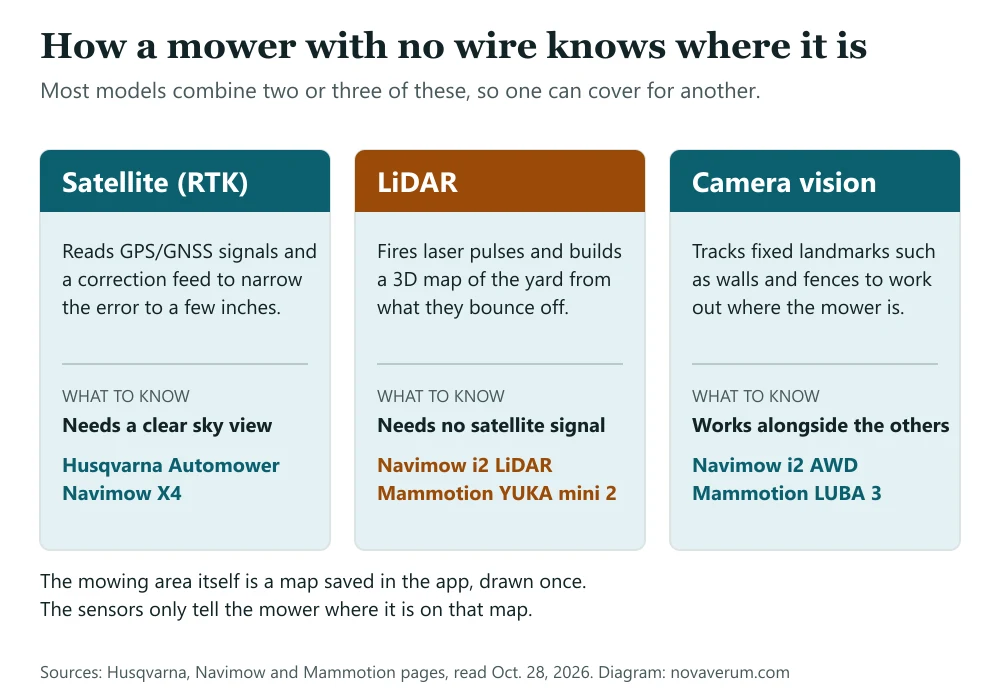
So the "edge" is a line on a saved map, not something the mower feels. Its real job is to know, at every moment, exactly where it is on that map. Three technologies do that, alone or together: satellites, lasers and cameras.
How does satellite (RTK) positioning work?
Normal GPS is accurate to a few meters, which is far too loose for a lawn. RTK (real-time kinematic) adds a correction signal. Navimow's own explainer says it reduces the error of standard GPS to a few inches by comparing what the mower receives with a fixed reference point.
Where that reference comes from differs by maker. Husqvarna describes its EPOS system as communicating with multiple satellites and the national cellular network to give centimeter-accurate location data. The Automower 440 iQ gets corrections through the Husqvarna Cloud or through the EPOS Reference Station that comes in the box, and Husqvarna says it needs no buried wire. On its commercial 560 EPOS page, Husqvarna puts the accuracy at approximately 2 cm.
Navimow and Mammotion use Network RTK instead of a base station in your yard. The correction comes over a cellular connection, so there is no antenna to mount. Navimow's i2 series pages list Network RTK as included at no extra cost, with the cellular data free, and Mammotion says the LUBA 3's NetRTK needs no setup and is free for the life of the product.
What happens under trees and next to the house?
This is the weak spot of satellite positioning, and the makers say so themselves. Husqvarna's buying guide asks how much of the sky you can see from your garden: some smart mowers use satellite signals to navigate, and the more open sky they can see, the better they find their way. Navimow's explainer goes further: under dense canopy, branches and leaves can deflect or block the signals, and a mower that relies only on RTK will show an error code and stop until someone rescues it.
That is why most models do not rely on satellites alone. Navimow's explainer, which is a maker's view, lists three fixes: cameras that track fixed anchor points such as walls and fences, LiDAR that works without satellite signals, and Network RTK that can switch between correction sources.
What do LiDAR and cameras add?
LiDAR is a spinning laser scanner. It sends out pulses, times how long they take to bounce back and builds a 3D map of the yard from the result. Because it measures the yard itself, it does not need a satellite. Mammotion's YUKA mini 2 page says "No RTK, No Limits, No Signal Issue," with a 360° LiDAR. The LUBA mini 2 AWD page pairs LiDAR with a dual-camera system, and Navimow's i2 LiDAR page says the LiDAR and vision combination works "even under trees or at night."
Cameras do two jobs. They help with position by tracking landmarks, and they spot obstacles. Navimow's X4 page lists 360° AI vision that detects more than 200 obstacles, and Mammotion says the LUBA mini 2's LiDAR and cameras detect and avoid more than 300 stationary or moving obstacles. Husqvarna's iQ series pairs its satellite system with onboard radar for obstacles.
The most complete setup is a mix. Mammotion calls the LUBA 3 AWD a tri-fusion system: 360° LiDAR, NetRTK and dual-camera AI vision. For another home robot that has to know exactly where its edge is, see our guide to window-cleaning robots.
How much do wire-free robot mowers cost?
From $669 for a small lawn to over $4,000 for two acres. The table lists one model per approach from each maker, with the prices shown in their U.S. stores on Oct. 28, 2026. Sales change these often.
| Model | Positioning, per the maker | Lawn size | Price |
|---|---|---|---|
| Navimow i105 | EFLS 2.0 positioning, cm-level; camera obstacle avoidance | 0.125 acre | $669 |
| Navimow i210 AWD | Tri-frequency Network RTK fused with vision | 0.25 acre | $1,299 |
| Navimow i215 LiDAR | LiDAR and vision, no antenna | 0.37 acre | $1,599 |
| Navimow X450 | Tri-frequency RTK and 360° AI vision | 1.5 acres | $2,999 |
| Mammotion YUKA mini 2 1000H | 360° LiDAR, no RTK | 0.25 acre | $1,399 |
| Mammotion LUBA mini 2 AWD | 360° LiDAR and dual-camera AI vision, no antenna | 0.37 acre | $1,799 to $1,999 |
| Mammotion LUBA 3 AWD 1500 | LiDAR, NetRTK and dual-camera AI vision | 0.37 acre | $2,399 |
| Husqvarna Automower 440 iQ | EPOS satellite positioning with onboard radar | Up to 2 acres | $4,299.99 |
Wire-free robot mowers by how they find their position, as described on the makers' U.S. pages on Oct. 28, 2026.
Husqvarna also sells a professional line. The CEORA, shown at the top, is listed for up to 6 acres with virtual boundaries only, and it is aimed at sports turf rather than home lawns.
What should your yard have for a wire-free mower?
The makers' pages point to a few things worth checking before you buy:
- Sky and trees. A mostly open lawn suits satellite positioning. If big trees or tall buildings cover part of it, look for LiDAR or a fusion system, as the makers recommend.
- Mobile signal. Network RTK needs a cellular connection. Navimow says the X4 can be limited where network signals are weak, and Husqvarna says Wi-Fi is not required but its mower connects over the cellular network.
- Service after the free period. Navimow lists free Network RTK for life on the i2 and X4, with 1 year of free 4G data on the i2. Its X4 Connect+ service is free for 1 year on the X430 and 2 years on the X450, then renews at $32.90 a year. Mammotion's LUBA mini 2 includes a 4G module with 3 years of data.
- Lawn size and zones. Navimow notes that all zones share one total map limit, so the sum of your mapped areas has to stay inside the mower's supported maximum.
- Obstacles. Cameras and LiDAR detect objects, but the counts are the makers' own claims: more than 200 obstacle types for Navimow and more than 300 for Mammotion.
Which approach fits which lawn?
A wide, open lawn with a clear sky is the easy case, and a satellite-based mower such as the Husqvarna iQ series or Navimow's RTK models is built for it. A lawn with trees, a covered side yard or walls close to the boundary is where LiDAR or a fusion of all three earns its higher price. And a small, simple yard may not need more than the entry models.
One thing does not change between them: the boundary is only as good as the map you draw. Take your time on the first mapping, check each zone in the app and add stay-out zones around flower beds and play areas. If you want to see how other home robots handle the same problem of finding their way around, read our guides to robot vacuums with arms and humanoid home robots.
Frequently asked questions
Do robot lawn mowers without wires need a base station or antenna?
It depends on the model. Husqvarna's Automower 440 iQ gets satellite corrections through the Husqvarna Cloud or the EPOS Reference Station included in the box. Navimow's i2 and X4 and Mammotion's LUBA 3 use Network RTK over a cellular connection, so there is no antenna to mount.
How accurate is RTK positioning on a robot mower?
Navimow says RTK reduces the error of standard GPS to a few inches. Husqvarna puts the accuracy of its satellite system on its commercial 560 EPOS at approximately 2 cm.
Can a wire-free robot mower work under trees?
Satellite-only models can struggle. Navimow's explainer says dense canopy can block signals and that a mower relying only on RTK will show an error and stop. Models with LiDAR or camera vision, such as Navimow's i2 LiDAR and Mammotion's LUBA mini 2 and YUKA mini 2, do not depend on satellites alone.
How do you set the boundary on a wire-free mower?
In an app. On Husqvarna's iQ series you drive the mower around the lawn to set virtual boundaries. Mammotion says you create the map manually or automatically, and Navimow offers one-tap Auto Mapping on the X4. You can edit the map later.
How much does a wire-free robot mower cost?
On the makers' U.S. pages on Oct. 28, 2026, prices in this guide ran from $669 for the Navimow i105 to $4,299.99 for the Husqvarna Automower 440 iQ. Lawn size is the main driver: the i105 is rated for 0.125 acre and the 440 iQ for up to 2 acres.
Is there a monthly fee for a wire-free mower?
Not always. Navimow lists free Network RTK for life on the i2 and X4, and its X4 Connect+ service is free for 1 or 2 years and then renews at $32.90 a year. Mammotion lists a 4G module with 3 years of data on the LUBA mini 2. Check the service terms of the model you pick.
Do wire-free mowers avoid pets and toys?
The makers say they detect obstacles. Navimow lists more than 200 obstacle types on the X4, Mammotion more than 300 on the LUBA mini 2, and Husqvarna uses onboard radar. These are the makers' own figures, so keep stay-out zones around areas where you leave things on the grass.
Sources
- Husqvarna U.S.: Automower 440 iQ (EPOS, setup, FAQ, price), read Oct. 28, 2026
- Husqvarna U.S.: Automower 560 EPOS (RTK-GNSS accuracy), read Oct. 28, 2026
- Husqvarna U.S.: robotic lawn mowers (CEORA and boundary types), read Oct. 28, 2026
- Husqvarna U.S.: Automower buying guide (sky view), read Oct. 28, 2026
- Husqvarna New Zealand: Automower 560 EPOS (correction data and reference stations), read Oct. 28, 2026
- Navimow Academy: How do wire-free robotic mowers work under thick tree canopies? (June 18, 2026)
- Navimow: i2 AWD (price, positioning, FAQ), read Oct. 28, 2026
- Navimow: X4 (price, positioning, Connect+, FAQ), read Oct. 28, 2026
- Navimow: i2 LiDAR (price, positioning), read Oct. 28, 2026
- Navimow: i105 (price, positioning), read Oct. 28, 2026
- Mammotion U.S.: LUBA 3 AWD (price, tri-fusion positioning, FAQ), read Oct. 28, 2026
- Mammotion U.S.: LUBA mini 2 AWD (price, LiDAR and cameras, FAQ), read Oct. 28, 2026
- Mammotion U.S.: YUKA mini 2 (price, LiDAR), read Oct. 28, 2026

Founder and editor, Novaverum
I write Novaverum to separate the technology you can really buy from the demos, concepts and viral fakes, starting from what the companies, regulators and engineers publish. Every article lists its sources at the end.