Future Transport
Jet Suit vs Jetpack vs Flyboard Air: What's the Difference?
Quick answer
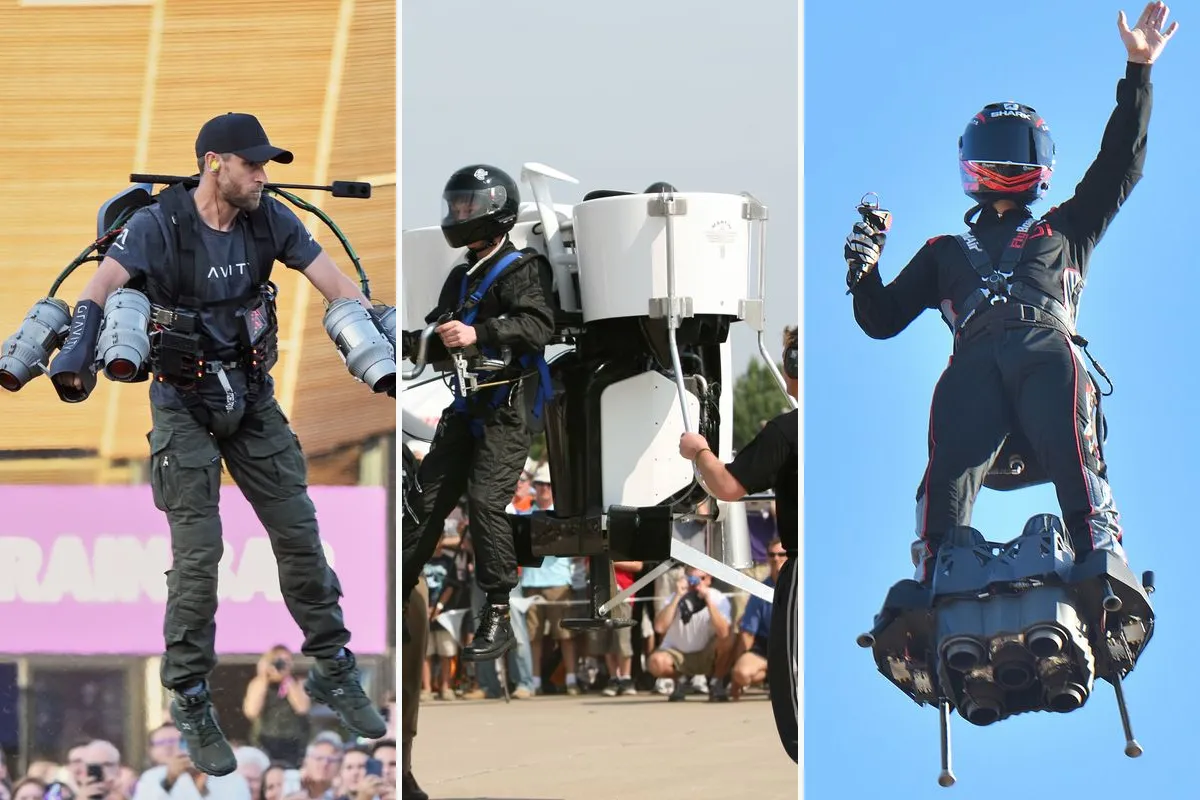
The difference is where the engines sit and whether you can ever try one. A jet suit (Gravity Industries) has small jet engines on the arms and back, and the pilot steers with the body. A jetpack (JetPack Aviation) carries its turbines on the back. The Flyboard Air (Zapata) is a board with five jet engines under the feet. Only the jet suit offers flights you can book, from £799 ($1,950).
On this page
- What is the difference between a jet suit, a jetpack and a Flyboard Air?
- How does a jet suit work?
- What happened in the first jet suit race in Dubai?
- What is a jetpack, and how is it different?
- What is the Flyboard Air?
- Which one can you actually try or buy?
- Where do these fit among other flying machines?
- Are these machines real or viral tricks?
- So which one is which?
- FAQ
- Sources
Videos of people flying with jet engines get called "jetpacks," "jet suits" and "hoverboards" almost at random. They are three different machines from three different companies, and only one of them is something you can book today. This guide sorts them out: where the engines sit, how each one is flown, how long it stays up and what you can actually do about it.
The facts come from each maker's own pages, Guinness World Records, press coverage and Gravity Industries' own video of the first jet suit race, each listed at the end. The numbers are the makers' figures, not independent tests, and we say so wherever it matters.
What is the difference between a jet suit, a jetpack and a Flyboard Air?
The short answer is the position of the engines. A jet suit spreads them over the arms and back, a jetpack puts them all on the back, and the Flyboard Air puts them under the pilot's feet. That changes how you steer, how hard it is to learn and who is willing to let you near one.
| Jet suit | Jetpack | Flyboard Air | |
|---|---|---|---|
| Maker | Gravity Industries (UK) | JetPack Aviation (California) | Zapata (France) |
| Where the thrust sits | Arms and back | Back | Under the feet |
| Engines | Arm engines plus three turbines on the back (current Mk4); seven in total on the Mark III flown in Dubai | Two turbojets (JB-10) or six (JB-11) | Five jet engines |
| How you fly it | Steer with arms and body; a hand throttle sets the power | Flight computer manages the turbines; pilots must complete the company's training | Stand on the board; Zapata says it takes "a high level of skill and fitness" |
| Flight time | About 3 minutes typical (Gravity) | 8 minutes (JB-10), 10 minutes (JB-11) | Up to 10 minutes (Guinness, 2016) |
| Top speed claimed | 85.06 mph Guinness record; "over 80mph" on Gravity's site | Over 120 mph | 93 mph (150 km/h) |
| Can you buy one? | No current price published | Company FAQ says its jetpacks are not for sale | No purchase link on Zapata's page |
| Can you try one? | Yes, from £799 ($1,950) on a tethered rig | No, per the company FAQ | No booking on Zapata's page |
The three machines side by side. All performance figures are the makers' own claims; sources read Oct. 28, 2026.
How does a jet suit work?
Gravity Industries, a British company, builds the best-known jet suit. Its site describes the current Mk4 as using "micro jet arm engines for upward thrust and three additional micro turbines in the back," and says its suits have "achieved flights of over 80mph." Guinness World Records lists the speed record at 85.06 mph, set on November 14, 2019, in a category for body-controlled suits, because the pilot points the thrust by moving the arms and body.
The controls are simple on paper. In Gravity's race video, the commentators explain that a throttle in the right hand sets the power and a switch in the left hand nudges it up or down. Everything else is balance, which is why first flights happen on a tether. Our jet suit guide covers the record, the flight prices and the air-ambulance and Royal Navy trials in detail.
What happened in the first jet suit race in Dubai?
Gravity staged the world's first jet suit race in Dubai on February 28, 2024, over the water near Dubai Marina, with the Dubai Sports Council, according to Global News. The company's own video of the day, "WORLD 1st Jet Suit Race: Dubai," premiered on March 30, 2024. It says eight pilots raced in jet-powered suits rated at more than 1,500 horsepower, in knockout heats before a final.
The video's narration gives the setup. The course was 1 km long with 5 m pylons, and every pilot flew the same suit: a Mark III weighing 30 kg with seven engines, two on each arm and three on the back. This race version had added flotation, so a pilot who fell in the water would float with the head out. A suit starts up within 15 seconds of the button press, and, the narrator says, burns 5 litres of fuel every minute.
The format was a time trial. Four heats of two pilots sent the four fastest to the final, and the fifth and sixth fastest raced each other in an "Eliminator" for the last spot. Five pilots flew the final, and Issa Kalfon, then 22, won it, with Paul Jones second. Global News described Kalfon as Gravity's deputy head of flight training and a former professional gymnast.
The day also showed the water-landing rule at work. Ahmed al-Shehhi, an Emirati pilot with only a couple of weeks in a jet suit, dropped into the water in his heat and came up giving a thumbs-up, AP reported. Gravity's commentators said he had flown through the hot exhaust of the suit ahead, which gives the engines less air to work with. Gravity's founder Richard Browning, who also raced, said afterward that "we've got to do this every weekend."
Press reports differ on some details. AP counted seven pilots and Global News described a 700 m course with 12 traffic points. We use Gravity's own figures here because they come from the organizer, and we say so.
What is a jetpack, and how is it different?
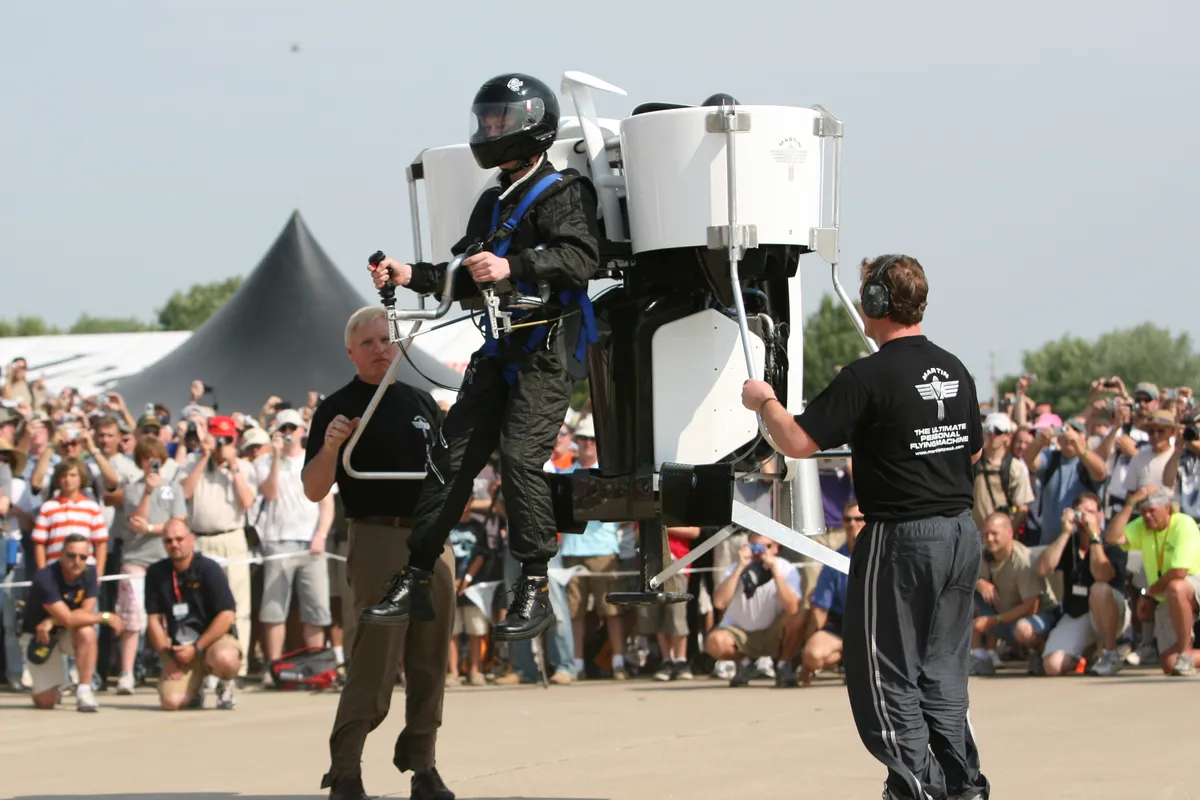
A jetpack carries all its engines on the pilot's back. JetPack Aviation's JB-10 uses two turbojets and, by the company's figures, weighs 83 lb empty, produces 395 lb of thrust and flies for about 8 minutes at more than 120 mph. The JB-11 uses six turbojets and lists 10 minutes. A flight computer helps manage the turbines, AVweb reported for the JB-12.
Two things set it apart from a jet suit. It is faster on paper, and it is far harder to get near: the company's own FAQ says "Our JetPacks are not for sale," and it does not offer trials. Reported sales were rare and large. Two JB-12 packs went to an undisclosed military customer at $400,000 each in 2021, according to New Atlas, and Robb Report wrote in 2024 that the company had sold five to private owners. Our guide to what JetPack Aviation sold has the full story, including why the team has since moved to drones.
What is the Flyboard Air?
The Flyboard Air is a flying platform you stand on, built by French inventor Franky Zapata. Zapata's page says it is "powered by 5 jet engines" and has a Jet A1 fuel tank, measures 77 x 51 x 48 cm and is "the smallest redundant manned aircraft ever built." It says flying it "requires a high level of skill and fitness."
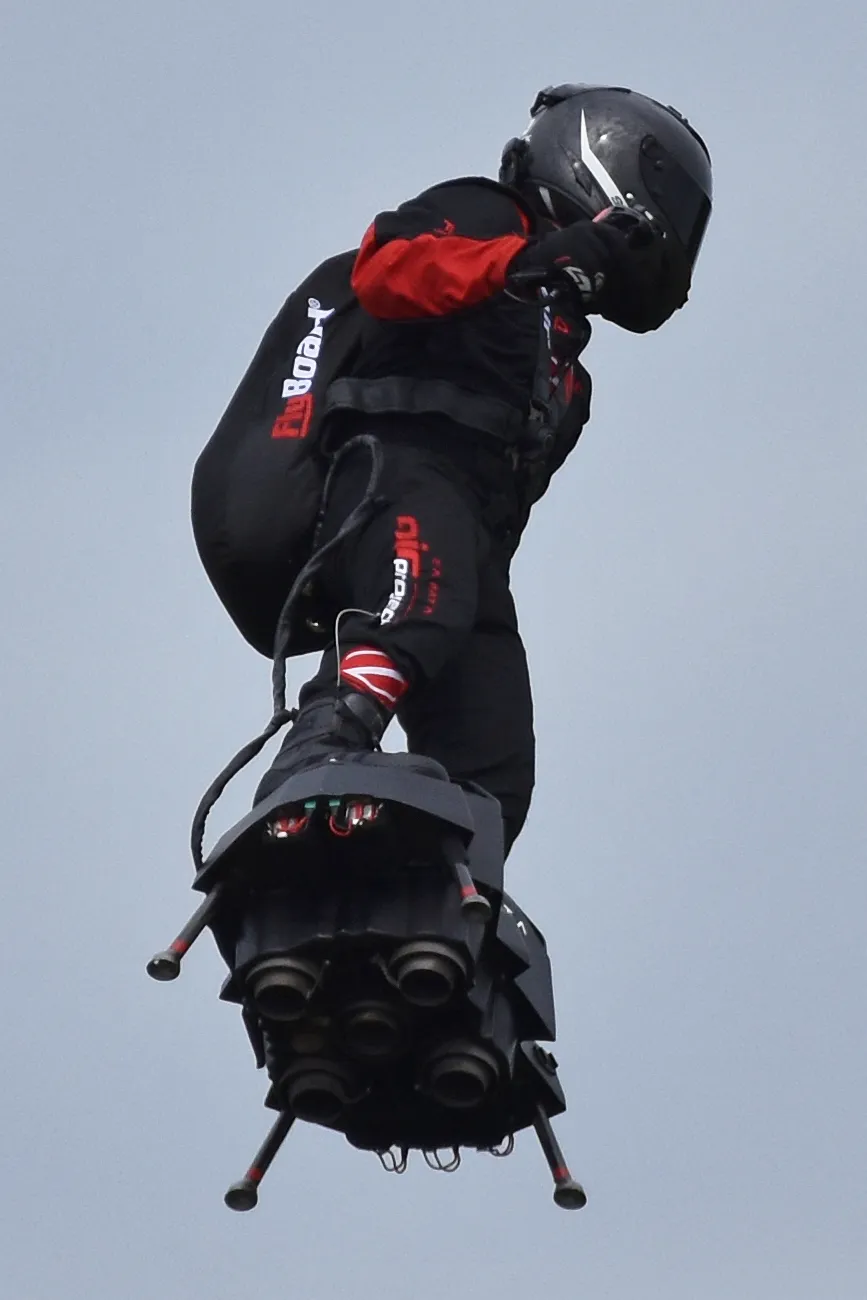
On April 30, 2016, it set the Guinness World Record for the farthest flight by hoverboard: 2,252 m (7,388 ft) off the coast at Sausset-les-Pins, flying 50 m above the surface. Guinness notes the device flies without a hose, unlike the original water Flyboard, which was tied to a personal watercraft, and lists claims of up to 10 minutes in the air and 150 km/h (93 mph). We cover it, and the boards that really float, in our real hoverboard guide.
It has stayed a showpiece. Wikipedia reports that Zapata's company received a €1.3 million grant from the French military, and that Zapata said the machine was not yet ready for military use, citing noise and how hard it is to learn. Zapata's page ends with "Stay tuned!" and offers no way to buy it.
Which one can you actually try or buy?
Only the jet suit. Gravity's flight experiences page listed, on October 28, 2026, the Rookie at £799 or $1,950, the Academy at £1,595 or $3,500 and the Maverick at £6,600 or $8,500 per person, with the Rookie flown "on the tethered training rig." A cheaper £199.99 tour covers a facility visit, with a test flight as an optional upgrade.
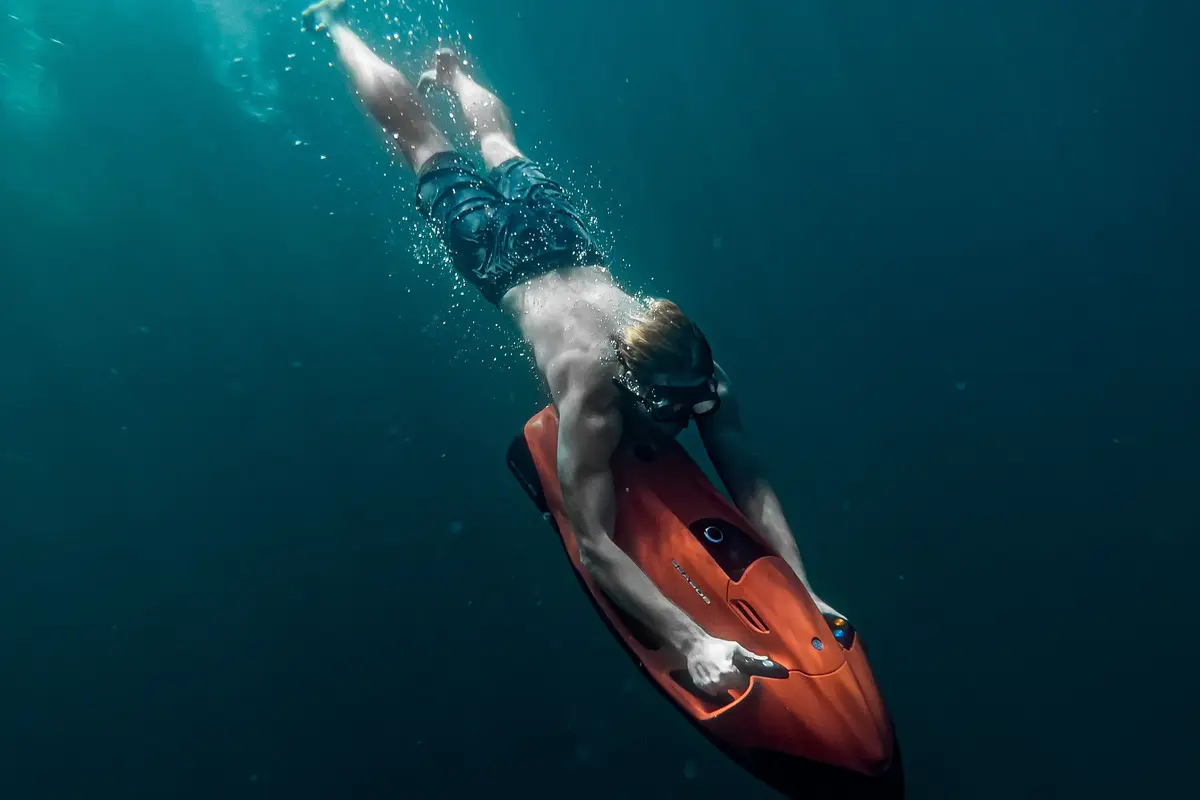
The jetpack is not offered on the open market, and the Flyboard Air has no booking or purchase page. If you want the same feeling on water, the closest thing on sale is the backpack-style scooter in our underwater jetpack guide.
Where do these fit among other flying machines?
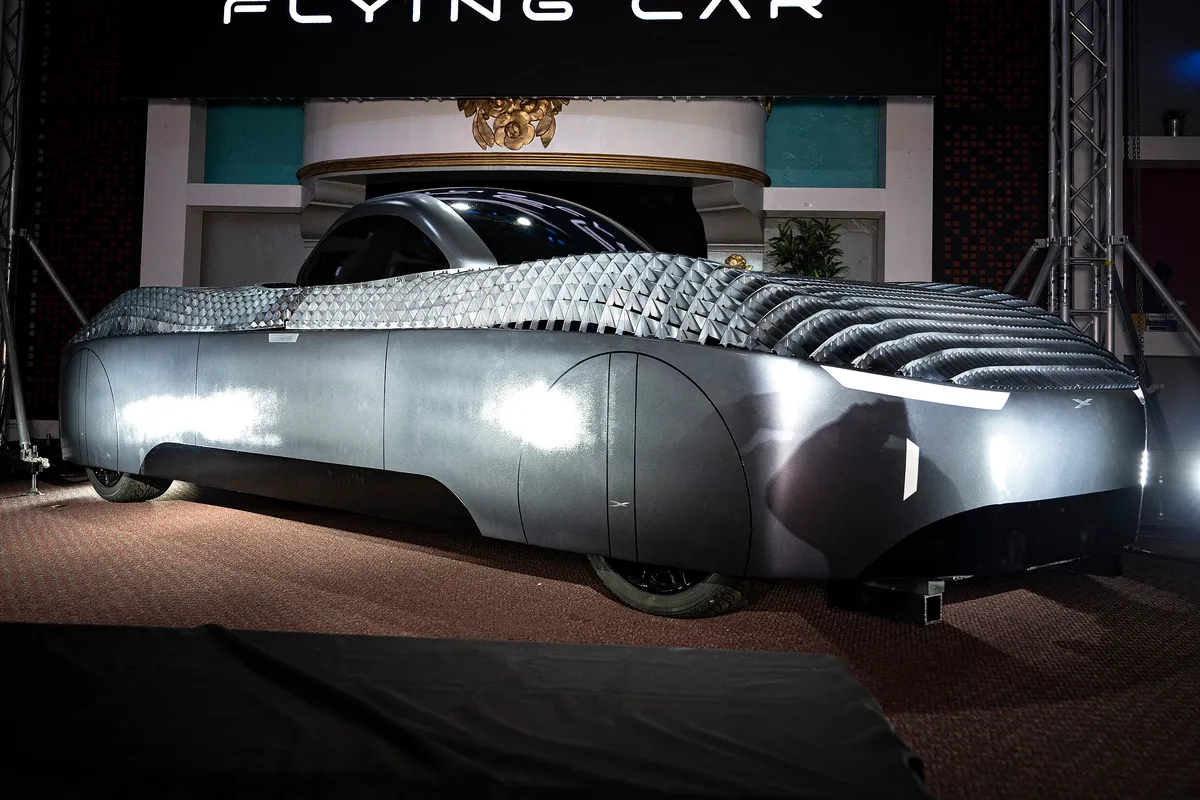
All three are one-person machines that burn fuel for minutes, closer to a stunt than a commute. The machines meant for carrying people to work are bigger: see our guides to the air taxi and the flying car, or browse all Future Transport articles.
Are these machines real or viral tricks?
Real. Each maker is a registered company with its own site, Guinness has recorded a jet suit and a hoverboard record, and a jet suit race was covered by Global News and AP. That passes the checks in our guide to spotting a fake gadget video.
What can mislead is the word "jetpack" on a shop page for a few thousand dollars with a delivery date. The real ones are the machines above.
So which one is which?
Jet suit: engines on the arms and back, flown with the body, about 3 minutes of flight and the only one you can book. Jetpack: everything on the back, up to 10 minutes and over 120 mph claimed, and not for sale. Flyboard Air: five engines under your feet, a record holder from 2016 with no public booking. If you want to feel one, start with a tethered jet suit session.
Frequently asked questions
What is the difference between a jet suit and a jetpack?
A jet suit puts small jet engines on the arms and back and the pilot steers with the body. A jetpack carries all its engines on the back. Gravity Industries makes the best-known jet suit, and JetPack Aviation made the JB-series jetpacks.
What is a Flyboard Air?
A flying platform you stand on, built by Franky Zapata. Zapata's page says it is powered by 5 jet engines and has a Jet A1 fuel tank. It set the Guinness record for farthest hoverboard flight, 2,252 m, on April 30, 2016.
How long can each one fly?
By the makers' figures: about 3 minutes for the Gravity jet suit, 8 minutes for the JetPack Aviation JB-10 and 10 minutes for the JB-11, and up to 10 minutes for the Flyboard Air according to Guinness. These are company claims, not independent tests.
Can you buy a jet suit, a jetpack or a Flyboard Air?
Not easily. Gravity publishes no current price for a suit, JetPack Aviation's FAQ says its jetpacks are not for sale, and Zapata's Flyboard Air page has no purchase link.
Can you try a jet suit?
Yes. Gravity Industries lists flight experiences from £799 ($1,950) for the Rookie session, flown on a tethered training rig, as of October 28, 2026.
Who won the first jet suit race?
Issa Kalfon won the first jet suit race in Dubai on February 28, 2024, according to Global News, ahead of Paul Jones in second, as shown in Gravity Industries' own video of the race.
Is the Flyboard Air the same as the water Flyboard?
No. The original Flyboard was a water toy fed by a hose from a personal watercraft. The Flyboard Air flies on its own jet engines with no hose, according to Guinness World Records.
Sources
- Gravity Industries: Innovation (Mk4 jet suit), read Oct. 28, 2026
- Gravity Industries: Flight Experiences (prices), read Oct. 28, 2026
- Guinness World Records: Fastest speed in a body controlled jet engine powered suit (Nov. 14, 2019)
- Global News: Jet suit race in Dubai (Mar. 1, 2024)
- VOA Learning English: In Dubai, a race for "Iron Men" wearing jet suits (Feb. 29, 2024)
- Zapata: Flyboard Air, read Oct. 28, 2026
- Guinness World Records: Franky Zapata sets new farthest hoverboard flight record (Apr. 30, 2016)
- Wikipedia: Flyboard Air, read Oct. 28, 2026
- New Atlas: JetPack Aviation makes first jetpack sales to unnamed military (Sept. 7, 2021)
- AVweb: Company exporting military jetpacks (Sept. 12, 2021)
- Robb Report, via Yahoo Tech: The world's first flying motorcycle could hit the skies by the end of the decade (Apr. 4, 2024)

Founder and editor, Novaverum
I write Novaverum to separate the technology you can really buy from the demos, concepts and viral fakes, starting from what the companies, regulators and engineers publish. Every article lists its sources at the end.